
How AI Auditing Reveals the Need for Cybersecurity Training
There's a growing gap between how fast AI is being adopted and how prepared teams are to secure it. AI auditing is emerging as a critical tool to surface this gap.
Artificial intelligence is now embedded in marketing, operations, customer service, and even security workflows. But as AI adoption accelerates, it’s exposing organisations to a new wave of cybersecurity risks, such as AI-powered cyberattacks. This is why more and more organisations are doing an AI audit.
Let’s take a step back and look at AI adoption. According to Microsoft’s Global AI Adoption 2025 report, AI diffusion reached 16.3% of the world’s population in the second half of 2025. That’s roughly one in six people now using generative AI tools.
Meanwhile, the World Economic Forum (WEF) finds that many businesses still struggle to translate heavy AI investment into enterprise-wide impact, with only 32% of organisations across industries reporting tangible business impact from AI.
The result is a growing gap between how fast AI is being adopted and how prepared teams are to secure it. AI auditing is emerging as a critical tool to surface these gaps. Businesses are now discovering why AI auditing is essential, what it uncovers, and why cybersecurity training is the most practical way to close the skills gap.
What Is AI Auditing?
AI auditing is a structured process used to evaluate whether AI systems are operating safely, fairly, transparently, and securely. Auditors examine:
- Data inputs: Are training and inference data protected and unbiased?
- Model behaviour: Does the system produce safe, reliable, predictable outputs?
- Access controls: Who can use the model, and how is access managed?
- Security safeguards: Are there protections against misuse, tampering, or adversarial attacks?
- Governance: Are there policies for oversight, accountability, and compliance?
According to the European Commission’s AI Act, AI audits are becoming a legal requirement for high-risk systems, particularly in areas like healthcare, law enforcement, and critical infrastructure.
Since more businesses are familiar with cybersecurity terms, we’ll put it this way — AI auditing is like a security risk assessment, but focused specifically on AI’s unique vulnerabilities.
It helps organisations understand where their AI tools could be exploited, how data could be leaked, and how outputs could be manipulated.
Why do AI systems need auditing?
AI systems are not inherently secure. They introduce risks that traditional software rarely faces. Several studies and reports highlight the scale of this challenge.
Adoption is outpacing security readiness
Firebrand Training's recent UK-wide survey of senior leaders across various industries found that just over three-quarters, or 77%, believe AI is increasing cyber risk for their organisation, but only 27% are fully prepared for AI-powered cyber attacks. This mismatch means most organisations are using AI without clear policies for risk management or security oversight.
AI introduces new attack surfaces
The US National Institute of Standards and Technology (NIST) came up with an AI Risk Management Framework that identify several AI-specific risks, such as data poisoning, prompt injection, and model inversion.
These are all methods that exploit AI used by enterprises to reveal sensitive information or perform unauthorised actions. These vulnerabilities don’t exist in traditional software, so they require specialised security knowledge.
Unfortunately, these incidents are already on the rise and businesses are also experiencing the hidden costs of these attacks.
Regulatory pressure is increasing
The European Union’s AI Act requires AI audits for high-risk systems, with penalties for non-compliance reaching up to €35 million or 7% of global revenue.
The U.S. is also advancing AI safety standards through the U.S. AI Safety Institute and NIST, pushing organisations to adopt formal auditing and risk management practices.
The skills gap is the core problem
In the same Firebrand survey, leaders reported skills gaps in risk controls (50%), information security (50%), incident response (42%), and infrastructure security (37%), with fewer but still notable gaps in auditing.
AI auditing is not a silver bullet. It’s a diagnostic tool that reveals a deeper issue. Without cybersecurity training, teams cannot properly secure AI systems, respond to incidents, or comply with regulations. Audits show you where the gaps are, and training is what closes them.
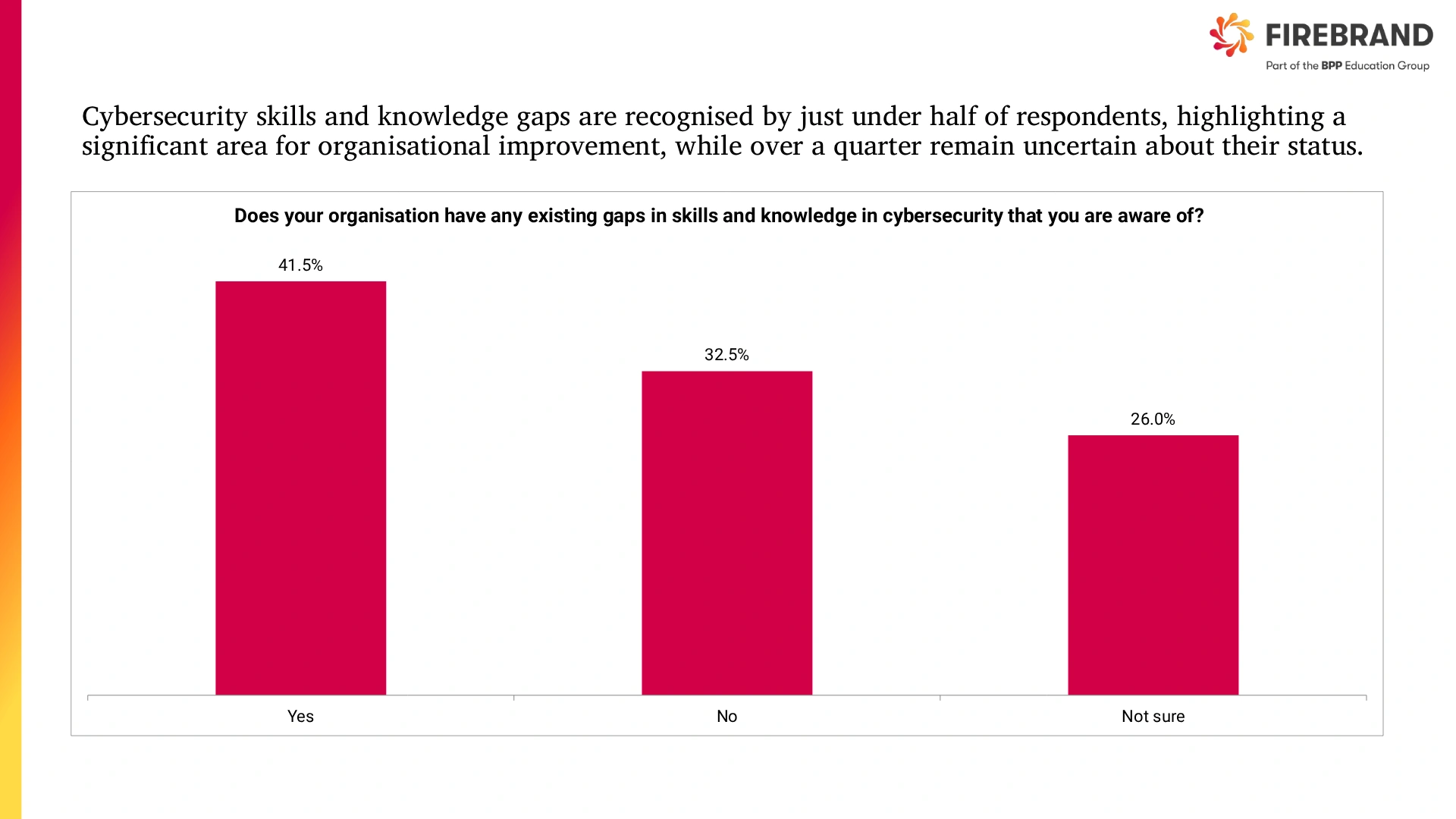
Over 41% of surveyed leaders across the UK recognise the gaps in skills and knowledge, Firebrand Survey, 2025
What an AI Security Audit Looks For
When organisations decide to audit their AI systems, the process centres on a set of core questions that reveal where security risks may lie.
An AI security audit is methodical as it traces data flows, examines access controls, tests outputs, and checks whether safeguards and oversight are functioning.
This is a sample checklist of what an AI auditor would ask and look for:
Where does data come from and how is it stored?
- Data sources: Are training and inference data from trusted, verified providers?
- Data quality: Has the data been cleaned, validated, and checked for bias?
- Data storage: Is data encrypted, stored securely, and protected against unauthorised access?
- Data lifecycle: Are retention policies clear, and is data deleted when no longer needed?
Who can access the system?
- User permissions: Are roles clearly defined and aligned with the principle of least privilege?
- Authentication: Is multi-factor authentication (MFA) enforced where appropriate?
- Administrative access: Are admin accounts tightly controlled and monitored?
- Third-party access: Are external vendors or integrations granted only the access they need?
How are outputs tested for misuse or error?
- Output validation: Are outputs checked for accuracy, consistency, and safety?
- Adversarial testing: Has the system been tested against prompt injection, adversarial inputs, or other attack methods?
- Error handling: Does the system respond appropriately when it encounters unexpected inputs?
- Bias and fairness: Are outputs tested for discriminatory or harmful patterns?
Are logs, alerts, and safeguards in place?
- Logging: Are all AI interactions, inputs, and outputs logged for review?
- Alerting: Are there automated alerts for unusual behaviour or suspicious activity?
- Safeguards: Are there technical controls like rate limiting, input filtering, or content moderation?
- Incident response: If a security event occurs, is there a clear process for response and recovery?
Do humans still review critical decisions?
- Human-in-the-loop: Are critical decisions reviewed by humans before being finalised?
- Approval workflows: Are there processes for escalating high-risk decisions?
- Accountability: Is there clear ownership for AI-driven decisions?
- Training: Do staff understand when and how to intervene in AI processes?

Why do these risks demand cybersecurity skills?
The security risks that AI introduces are not the same as the risks associated with traditional software. They demand a deeper, more specialised understanding of threats, vulnerabilities, and secure system design. General IT knowledge alone is not sufficient to address them.
AI security issues require more than general IT knowledge. IT teams are often trained to manage networks, servers, and applications, but AI systems introduce complexities that go beyond these areas.
For example, model inversion attacks allow attackers to extract information about the training data by probing the model. Adversarial inputs can cause AI systems to misclassify or malfunction in ways that traditional software would never experience.
Cybersecurity is the skill set that helps teams handle AI safely.
Why train at Firebrand to secure your AI systems
You now understand the risks AI introduces, what an audit looks for, and why cybersecurity skills are essential to handle them safely. The next step is clear: build the capability your organisation needs through structured cybersecurity training.
Nobody prepares you faster than Firebrand, UK’s leading IT and technology certification specialist. Firebrand is recognised as a top-20 global IT training company for fifteen years and a five-time Microsoft Learning Partner of the Year. Firebrand’s approach is built on one principle: accelerated learning that turns knowledge into real-world performance from day one.
For teams working with AI, this speed is critical. The faster your workforce gains cybersecurity skills, the faster you can secure your AI systems, reduce risk, and meet regulatory requirements.
Firebrand’s Lecture-Lab-Review model is their accelerated learning framework. Learners move between focused instruction from industry experts with real-world experience, hands-on labs that mirror real-world threats and scenarios, and structured review sessions that reinforce capability through practice and feedback.
This immersive approach ensures learners gain practical, job-ready cybersecurity skills fast, not just theoretical knowledge.
Cybersecurity courses that cover AI risks
Firebrand offers a broad portfolio of globally recognised cybersecurity certifications, including CISSP (Certified Information Systems Security Professional), CEH (Certified Ethical Hacker), CISM (Certified Information Security Manager), and more.
These courses cover the core capabilities needed to secure AI systems: threat detection, risk assessment, secure system design, access controls, incident response, and governance.
Firebrand also delivers training in Generative AI & Data Science, so you can build skills across both cybersecurity and AI, and this is the exact intersection where AI security risks emerge.
With a 97% learner satisfaction rating and first-time pass rates above the industry average, Firebrand has proven results that organisations across the UK and Europe trust.
AI is changing the security landscape. The professionals who want to stay relevant and the organisations that want to stay secure will need cybersecurity training to assess, protect, and govern these systems effectively. Firebrand is the partner that gets you there faster.
Enquire about Firebrand Training