
AI Cyber Attacks in Healthcare: Why Cybersecurity Training Is Now Essential for Patient Safety and Organisational Resilience
Tasks that once required specialist expertise can now be performed by less experienced attackers at scale. Is your healthcare provider at risk?
Healthcare organisations have long been a prime target for cybercriminals. The sector holds some of the most valuable personal data available, relies on highly interconnected digital systems, and cannot afford operational downtime when patient care is at stake.
Today, however, healthcare leaders face a new challenge. Artificial intelligence (AI) is transforming the cyber threat landscape, enabling attackers to launch more sophisticated, convincing, and scalable attacks than ever before.
For hospitals, clinics, and healthcare providers, cybersecurity is no longer simply an IT issue. It is a patient safety issue, a financial risk, and a board-level governance concern.
While many organisations continue to invest in cybersecurity technology, there is growing recognition that technology alone cannot address the risks posed by AI-powered threats. Building a cyber-resilient workforce is becoming just as important as deploying the latest security tools.
Why is AI making healthcare cyber attacks more dangerous than ever?
Cybercriminals have always adapted quickly to new technologies, and AI is proving no exception.
Generative AI can now create highly convincing phishing emails, realistic fake websites, malicious code, and even deepfake voice recordings. Tasks that once required specialist expertise can now be performed by less experienced attackers at scale.
This shift is already influencing how organisations perceive cyber risk. In the latter half of 2025, Firebrand did a survey across the UK among senior leaders across energy, financial services, retail, telecoms, professional services, and IT. Results show that more than three-quarters (76%) of senior decision-makers believe AI has increased cybersecurity risks within their organisations. Furthermore, more than one-third reported that AI-powered threats had increased their cyber risk by between 10% and 49%.
Healthcare organisations are particularly vulnerable because attackers can exploit both technology and human behaviour.
Why are healthcare organisations vulnerable to cyber attacks?
Healthcare is one of the most attractive targets for cybercriminals because it combines highly sensitive patient data, time-critical operations, and complex technology environments.
In fact, healthcare remained the most expensive industry for breach recovery for the 14th consecutive year, with an average cost of USD 9.77 million per breach, according to the IBM Healthcare Industry Attack Trends.
Here are reasons why health organisations are more vulnerable to attacks:
Healthcare staff operate in high-pressure environments
Most healthcare professionals work in fast-paced settings where every second matters.
Doctors, nurses, pharmacists, laboratory technicians, and administrative staff make constant decisions while balancing urgent patient needs, which means cybersecurity checks can become secondary to immediate clinical priorities. Shift work and fatigue increase the risk further.
Cybercriminals exploit this pressure through phishing and social engineering messages that appear urgent, such as fake patient updates, policy notices, or requests from senior leadership. And according to the same study by IBM, healthcare incidents are often timed for weekends, holidays, or overnight periods when staffing and monitoring may be lighter.
Clinical priorities compete with security
Healthcare professionals are trained to prioritise patient care above all else, and that can create tension with security procedures. In practice, that may lead staff to share credentials, bypass controls, or use informal communication channels to keep care moving.
These actions are usually well-intentioned, but they can create openings that attackers are quick to exploit.
Healthcare has a large human attack surface
Healthcare organisations also have a particularly broad human attack surface, due to how hospitals and other relevant organisations are structured.
Potential targets include:
- Clinicians and nursing staff
- Administrative personnel
- IT teams
- Researchers
- Contractors
- Temporary staff
- Third-party suppliers
- Medical device vendors
- External consultants
Each group requires access to different systems, applications, and data sources, so managing access securely across such a large and varied ecosystem can become a complex challenge.
That creates many possible entry points, and attackers often need only one compromised account to gain a foothold.
Legacy systems and connected devices
Healthcare organisations also face structural weaknesses that make defence harder. According to the US Administration for Strategic Preparedness and Response (ASPR), the health sector continues to deal with vulnerable legacy systems, underfunded cybersecurity programs, a shortage of skilled security professionals, and network-connected medical technologies.
Because of these issues, it has become difficult to patch quickly and secure all parts of the environment consistently.
This is especially important because medical devices and operational technology can be directly affected by cyberattacks.
A 2026 Report on Medical Device Cyberattacks found that 24% of surveyed healthcare organisations experienced an attack on a medical device, and 80% of those incidents had a moderate or significant impact on patient care. That makes healthcare different from many other industries. An attack may begin as a data security issue but quickly become a clinical safety issue.
What Is The Real Cost of a Cyber Attack in Hospitals and Other Healthcare Units?
When discussing cyberattacks, the focus often falls on ransomware payments or regulatory fines. However, the true impact is typically much broader.
In the same Firebrand survey across the UK, results also showed that almost half (47%) of organisations experienced at least one cyberattack in the previous 12 months. More concerningly, among organisations that were attacked, 73% experienced multiple incidents.
Of course, the financial impact can be substantial. Nearly one in five organisations reported losses between £100,000 and £199,999 following cyberattacks, while almost one in ten experienced costs exceeding £1 million. These figures include recovery costs, reputational damage, business disruption, and regulatory penalties.
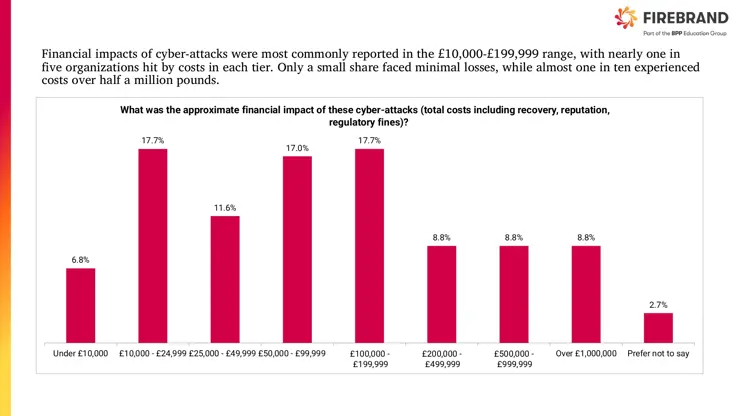
Financial cost of cyberattacks, Firebrand survey
But apart from the upfront costs, there are also many hidden costs to these cyber attacks.
Financial losses extend far beyond ransom payments
When cyberattacks make headlines, attention often focuses on ransom demands. In reality, ransom payments are only one part of the total cost.
Organisations may also face incident investigation costs, system restoration expenses, regulatory fines, legal fees, customer notification costs, public relations support, increased cyber insurance premiums, and productivity losses.
For healthcare providers operating under tight financial constraints, these costs can have long-term consequences for investment and service delivery.
Cyberattacks disrupt clinical operations
Healthcare organisations depend on uninterrupted access to information. When systems become unavailable, clinical workflows can quickly break down. Potential consequences include EHR outages, appointment cancellations, delayed diagnostics, disrupted communications, delayed discharge processes, and reduced access to laboratory results.
Firebrand’s research from the survey found that 46% of organisations experienced temporary business downtime following cyberattacks, while 42% reported productivity impacts. In healthcare, even short disruptions can create significant operational challenges because they affect both administrative efficiency and patient-facing care.
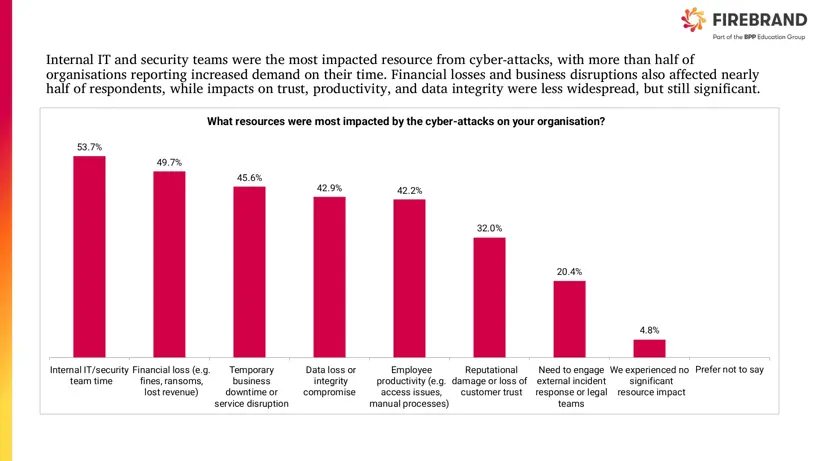
The hidden costs of cyber attacks, Firebrand survey
This risk becomes harder to manage when organisations rely on legacy systems or third-party platforms that cannot be patched quickly or integrated cleanly into modern security controls. The more fragmented the environment, the harder it becomes for understaffed security teams to maintain visibility and respond quickly.
Cyber incidents can impact patient safety
Perhaps the most concerning consequence of a cyberattack is its potential effect on patient care. While cyber incidents rarely cause direct physical harm, they can create conditions that increase risk. Delayed access to patient records may slow clinical decision-making, disrupted workflows may increase administrative burdens on staff, and reduced access to critical systems can affect coordination between care teams.
Appointment cancellations may delay diagnosis or treatment, and in some cases, staff may be forced to rely on paper-based processes or workaround communications that increase the chance of error. This is why many healthcare leaders increasingly view cybersecurity as an extension of patient safety and clinical governance.
Leadership teams pay the price
The impact of a major cyberattack extends far beyond the IT department. Senior leaders often find themselves managing crisis communications, regulatory reporting, media enquiries, board briefings, recovery planning, and stakeholder reassurance all at once.
In many cases, strategic initiatives are delayed while leadership teams focus on incident response. Reputational damage can also persist long after systems have been restored, especially in healthcare, where patients, partners, regulators, and other stakeholders expect organisations to protect sensitive information.
As cyber threats continue to evolve, boards and executive teams are increasingly expected to demonstrate active oversight of cybersecurity risk. That means investing not only in technology, but also in training, simulation exercises, and cross-functional incident response readiness.
Why AI threats require new skills and new training approaches
While awareness training remains important, AI-powered threats are changing what organisations need from cybersecurity education.
Traditional annual compliance courses were not designed to address AI-generated phishing attacks, adversarial AI techniques, or modern ransomware operations. However, many teams remain underprepared.
In Firebrand’s survey, only 27% of organisations reported that their teams are fully trained to respond to AI-driven cyber threats. More than half described their teams as only somewhat prepared, while nearly one in eight admitted they had no training in this area.
This skills gap in cybersecurity represents a significant risk.
Healthcare leaders should consider whether their current training programmes adequately address:
- AI-enhanced phishing attacks
- Social engineering techniques
- Incident response procedures
- Cloud security
- Identity and access management
- Governance, risk, and compliance
- Emerging AI security risks
- And more…
Why Training Is One of the Most Effective Ways to Reduce Cyber Risk
The encouraging news is that training works.
According to the research, 86% of organisations believe ongoing certification training has reduced their cybersecurity risk. More than one-third reported a significant reduction in risk.
Even more compelling, organisations that measured outcomes reported an average risk reduction of approximately 47% following certification training initiatives. Nearly half reported reductions exceeding 50%.
The most frequently reported benefits included:
- Fewer successful cyberattacks
- Faster incident response
- Reduced operational downtime
- Improved compliance outcomes
These are outcomes that matter directly to healthcare organisations, where operational continuity and patient safety are essential.
It's therefore unsurprising that 73% of organisations have increased cybersecurity training specifically in response to AI-related risks.
How can the healthcare industry strengthen its cybersecurity?
As cyber threats become more sophisticated, healthcare organisations need professionals equipped with up-to-date cybersecurity knowledge and industry-recognised certifications.
As a Training Partner, Firebrand helps organisations develop practical cybersecurity expertise through accelerated courses and certifications covering areas such as information security, governance and risk management, incident response, cloud security, ethical hacking, and security leadership.
Firebrand has been helping clients from different industries — including the healthcare sector — since 2001, saving employers more than a million hours in training time.
Whether you're looking to strengthen your internal security team, improve organisational resilience, or prepare for emerging AI-driven threats, investing in professional cybersecurity training can help reduce risk while building long-term capability.
Discover how Firebrand can help your organisation build the cybersecurity skills needed for today's evolving threat landscape.
Enquire about our training partnership