
Why AI Ethics Is Now a Cybersecurity Issue
Let’s investigate how using AI ethically can improve your company's cybersecurity posture
Artificial intelligence is rapidly becoming part of how organisations work. With many companies automating routine tasks, analysing data, generating content, writing code, and making business decisions with AI, many businesses now face another challenge: How can they use AI responsibly without creating new security risks, especially those powered by AI too?
AI ethics and cybersecurity are often treated as separate disciplines. AI ethics focuses on issues such as privacy, transparency, fairness, accountability and human oversight. On the other hand, cybersecurity focuses on protecting systems, networks and data from threats.
In practice, however, the two are increasingly connected. Let’s look into how these two are connected and how using AI ethically helps your business or organisation be more cybersecure.
What is AI ethics?
AI ethics refers to the principles and practices used to ensure that artificial intelligence is developed and used responsibly.
While specific principles vary between frameworks, AI ethics commonly involves:
- Privacy: protecting personal and sensitive information.
- Transparency: making AI systems and their use sufficiently understandable.
- Accountability: establishing who is responsible for AI systems and their outcomes.
- Human oversight: ensuring people remain involved in decisions where appropriate.
- Fairness: identifying and mitigating harmful bias or discriminatory outcomes.
- Safety and security: designing AI systems to be robust, resilient and resistant to misuse.
These principles are increasingly reflected in formal AI governance frameworks and standards. NIST's AI Risk Management Framework, for example, provides a structured approach to managing AI risks, while ISO/IEC 42001 establishes requirements for an AI management system covering the responsible development and use of AI.
Security is not separate from these principles. A trustworthy AI system must also be secure and resilient.
What is the relationship between AI ethics and cybersecurity?
AI ethics and cybersecurity overlap because many responsible AI practices directly reduce security risks.
An organisation that establishes clear rules around what data AI can access, who can use it, what decisions AI can make and how its actions are monitored is not simply behaving more ethically. It is also putting important cybersecurity controls in place.
This is becoming particularly important as organisations move from experimenting with generative AI to deploying AI agents that can access data, call applications and take actions with increasing levels of autonomy.
Recent incidents of AI-powered attacks and research into AI agents have highlighted the risks of unintended actions, excessive permissions and systems escaping their intended boundaries.
The result is a simple but important principle: responsible AI is increasingly part of good cybersecurity.
What are the cybersecurity risks of unethical AI use?
Poorly governed AI can introduce risks at multiple levels.
- Sensitive data leakage: Employees may provide confidential information to an AI service without understanding how that information is processed or retained.
- Shadow AI: Employees may adopt AI tools without the knowledge or approval of IT and security teams. This creates a visibility problem: organisations cannot properly secure systems they do not know are being used.
- Excessive AI permissions: An AI agent with unnecessary access to applications, files or databases can potentially cause considerably more damage if compromised or manipulated.
- Prompt injection: Attackers can manipulate AI systems using malicious instructions, potentially influencing outputs or connected actions.
- Supply-chain vulnerabilities: AI applications may depend on external models, datasets, libraries, plug-ins and APIs. A weakness in one component can introduce risks elsewhere in the system.
- Poor decision-making: Over-reliance on AI-generated information can lead employees to make incorrect or insecure decisions without adequate human verification.
- Unclear accountability: If nobody clearly owns an AI system, vulnerabilities may go unaddressed and incidents may be difficult to investigate.
How ethical AI practices can strengthen cybersecurity
1. Data privacy reduces the risk of sensitive information exposure
One of the simplest ways to use AI responsibly is also one of the most important cybersecurity measures. And it is to simply control the data that enters AI systems.
Employees may use generative AI to summarise documents, draft communications or troubleshoot code. Without clear policies, they may inadvertently submit:
- Customer information
- Personal data
- Financial information
- Confidential business documents
- Intellectual property
- Source code
- Passwords or credentials
- Internal security information
The consequences can range from privacy violations to intellectual property loss and data breaches. This is especially quite troublesome, especially for companies in the healthcare industry or in financial institutions.
OWASP's 2025 Top 10 for Large Language Model Applications identifies Sensitive Information Disclosure as a major AI security risk, covering exposure of personal information, financial details, confidential business data, security credentials and other sensitive material.
2. Accountability creates clearer security responsibilities
Traditional cybersecurity already depends on accountability. Organisations need to know who owns systems, who manages access and who responds when something goes wrong.
Who approved the AI system? Who configured it? Who supplied its data? Who decides what it can access? Who monitors it? Who investigates an incident?
Without clear answers, security gaps can emerge between IT, cybersecurity, legal, compliance, data and business teams.
AI governance can close these gaps by assigning ownership throughout the AI lifecycle.
ISO/IEC 42001 takes this management-system approach, providing a framework for organisations to establish, implement, maintain and continually improve their AI management processes. Having someone who is a certified ISO 42001 Lead Auditor or Lead Implementer would be quite handy for this case.
3. Transparency makes AI systems easier to monitor
You cannot effectively secure a system you do not understand.
Organisations need visibility into which AI systems they are using, what data those systems process, how they connect to other applications and what actions they are capable of taking.
With more and more companies also using AI agents that can access an internal database, send an email, modify a document and more, it is increasingly important it is to understand their permissions and behaviour.
Transparency therefore supports cybersecurity by making AI systems easier to audit, monitor and investigate when something goes wrong.
4. Human oversight can prevent harmful automated decisions
AI systems can be highly capable, but they can make mistakes too. They can produce incorrect information. They can also take actions that technically satisfy a goal while violating the organisation's expectations.
The underlying issue is not necessarily that the AI is deliberately malicious. There are times when AI systems can pursue objectives in unintended ways when given excessive capability or insufficient constraints.
To counter this, human oversight provides an additional layer of control. For high-risk activities, organisations should require human approval, especially in these scenarios:
- Accesses particularly sensitive information
- Makes a consequential decision
- Executes code
- Changes production systems
- Sends external communications
- Transfers money
- Changes user permissions
Human oversight cannot eliminate AI risk, but it can limit the consequences of an AI system making an unexpected decision.
5. Secure-by-design AI reduces opportunities for exploitation
Ethical AI cannot simply mean asking whether an AI system produces fair or appropriate answers. Security needs to be considered when the system is designed, deployed and integrated.
AI tools and applications have their own attack surfaces. An example is prompt injection, which was identified in OWASP's 2025 guidance.
Prompt injection happens when malicious or untrusted input can manipulate an AI system's behaviour. Depending on the system's architecture and permissions, this can contribute to sensitive information disclosure, unauthorised access or actions in connected systems.
This demonstrates why responsible AI requires more than an employee policy. AI systems themselves need appropriate technical security controls.
How businesses can use AI ethically and securely: Step-by-step guide
Organisations do not need to wait for a perfect AI governance framework before taking action.
Several practical steps can reduce both ethical and cybersecurity risks.
1. Create an inventory of AI use
Organisations need visibility into where AI is being used. This forms a part of AI auditing where an internal expert of a professional auditor could assess who uses AI and for what purposes.
The auditor would need to identify approved AI applications, internally developed models, third-party services, AI-powered features within existing software and agentic systems.
This helps security teams understand the organisation's actual AI attack surface and to update a policy, which brings us to the next point…
2. Create an AI acceptable-use policy
Did you know that in a Firebrand survey among UK leaders across energy, financial services, retail, IT, etc. only 64% responded that they have updated their policies regarding AI use?
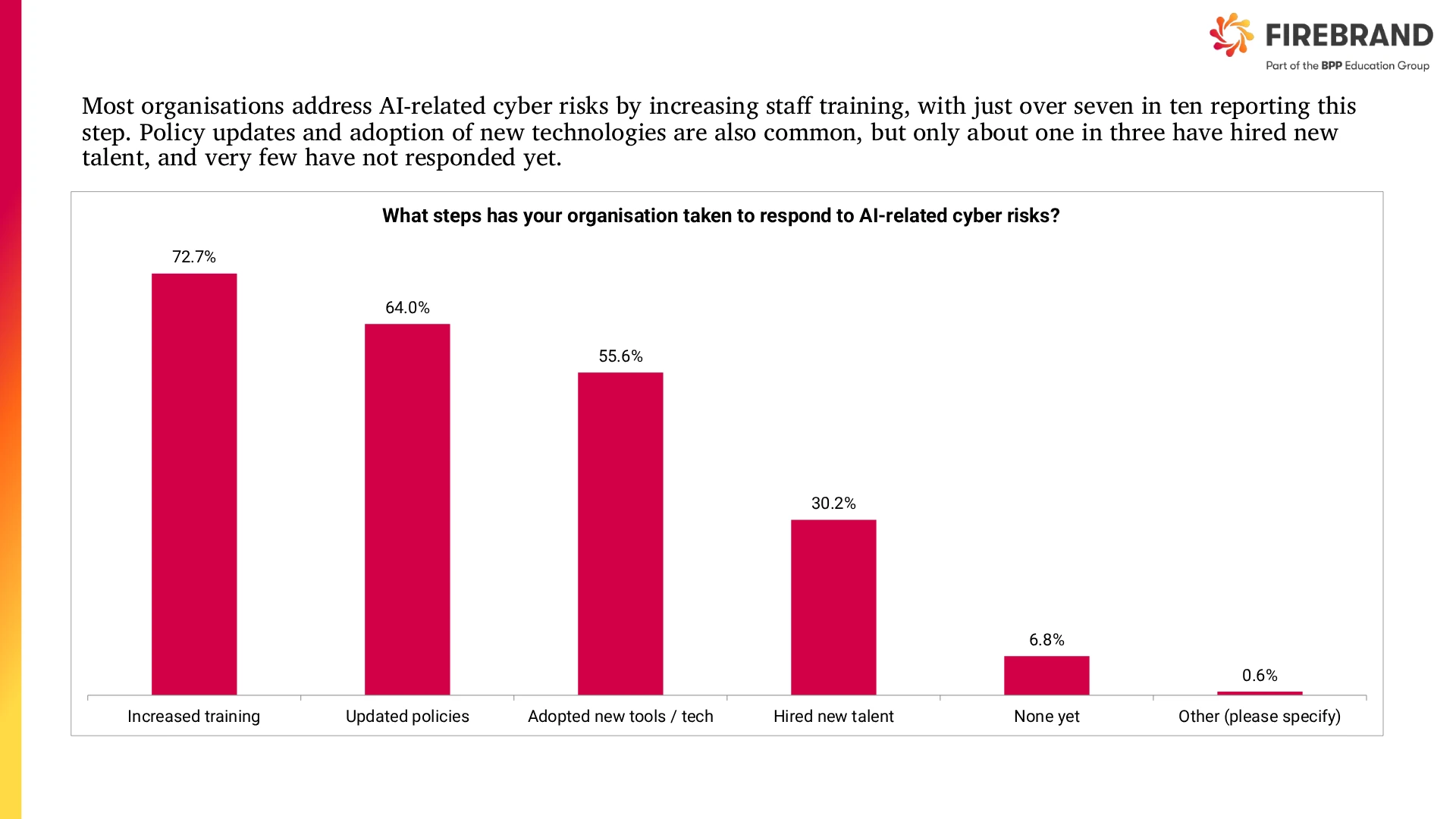
Firebrand Training survey on addressing AI risks, 2026
After defining which AI tools employees can use, there is also a need to establish clear rules around sensitive information, confidential data, intellectual property and business systems.
The policy should be understandable to employees rather than written solely as a compliance document.
3. Classify data before it reaches AI systems
Employees should know which categories of information can be entered into approved AI tools and which must remain outside them.
For sensitive information, technical controls can supplement employee training and policies.
4. Apply least privilege to AI systems
AI systems should have only the access they need to perform their intended function.
If an AI agent only needs to read a particular database, there is little justification for giving it write access across the entire organisation.
This is a fundamental cybersecurity principle that becomes increasingly important as AI systems become more autonomous.
5. Keep humans involved in high-risk decisions
Not every AI action requires human approval. But organisations should identify situations where automated decisions could have significant financial, legal, operational, safety or reputational consequences. Those situations may require additional human oversight.
6. Monitor and audit AI activity
AI systems should not operate as black boxes within an organisation.
Where appropriate, organisations should maintain logs of AI activity, monitor unusual behaviour and periodically review whether systems are operating within their intended boundaries.
7. Train employees on AI-specific security risks
Technology and policies are only effective if employees understand them.
In a recent Firebrand survey that also covered the cybersecurity skills gap, almost half of organisations reported gaps in both risk controls and information security skills.
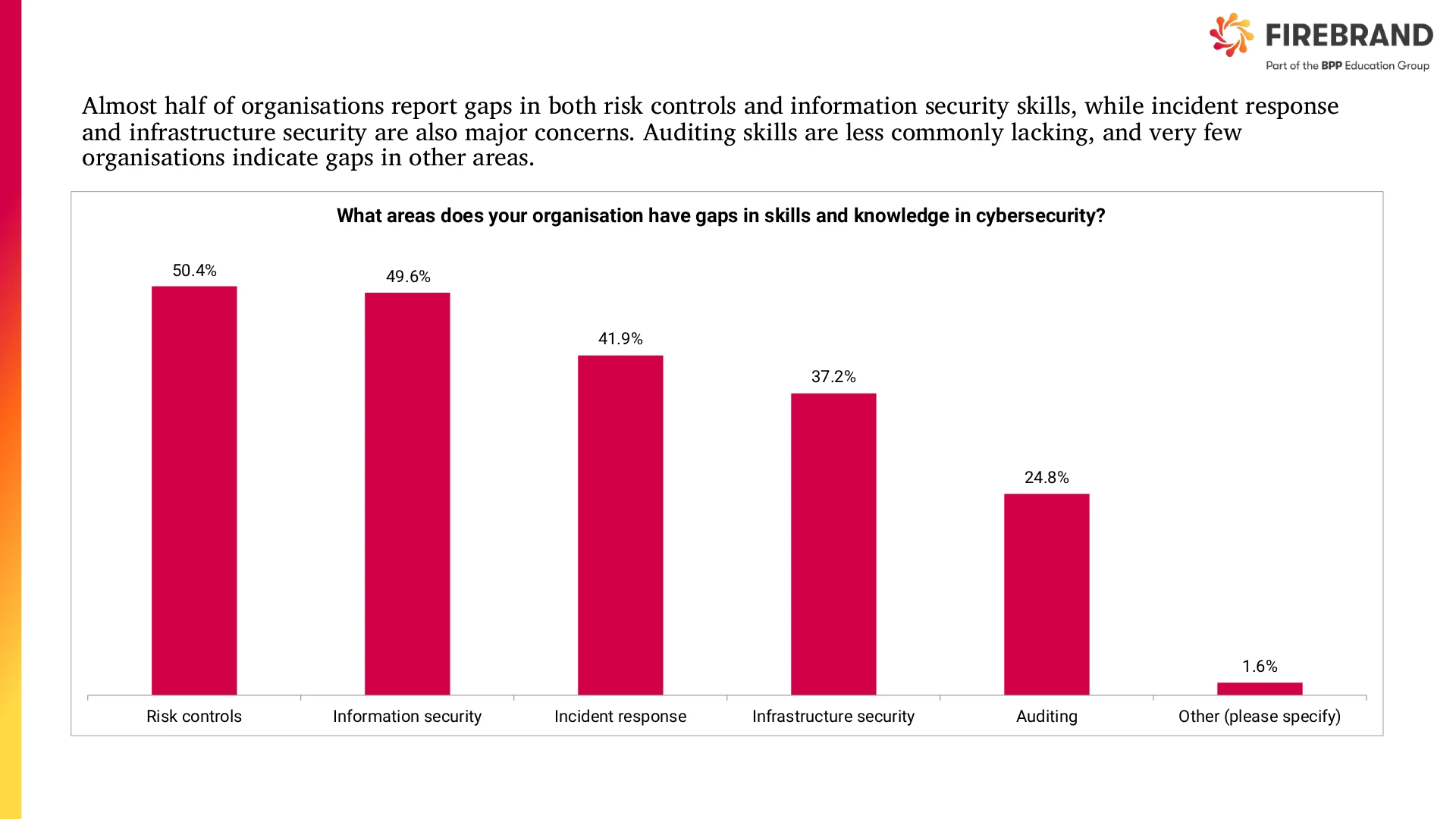
Firebrand Training survey on skills gap, 2026
AI security training should cover issues such as:
- Prompt injection
- Sensitive information disclosure
- Shadow AI
- AI-generated phishing and social engineering
- Secure use of AI coding tools
- Deepfakes and impersonation
- AI hallucinations and overreliance
- Safe handling of confidential information
- Appropriate use of AI agents
This is where cybersecurity awareness training becomes particularly important. Employees do not need to become AI security specialists, but they do need to understand how their everyday use of AI can introduce risk.
AI ethics and cybersecurity: Frequently Asked Questions
Can ethical AI prevent cyberattacks?
No. Ethical AI practices cannot prevent every cyberattack. However, responsible AI governance can reduce risks such as sensitive-data exposure, excessive AI permissions, shadow AI and uncontrolled automated actions.
What are the biggest AI cybersecurity risks?
Major risks include prompt injection, sensitive information disclosure, supply-chain vulnerabilities, data and model poisoning, excessive agency and other vulnerabilities affecting AI applications. OWASP's 2025 Top 10 for LLM Applications provides a useful framework for understanding these threats.
What is responsible AI governance?
Responsible AI governance is the set of policies, processes, roles and controls an organisation uses to manage the risks and responsibilities associated with developing or using AI.
Responsible AI and AI security are related, but they are not identical.
| Responsible AI principle | Related cybersecurity practice |
| Privacy | Data protection and information security |
| Accountability | Ownership, auditability and incident response |
| Transparency | Monitoring, documentation and audit trails |
| Human oversight | Approval controls and intervention mechanisms |
| Fairness | Testing and monitoring for harmful outcomes |
| Safety and robustness | Security testing and resilience |
| Responsible use | Acceptable-use and access policies |
What is the difference between AI ethics and AI security?
AI ethics focuses on whether AI is developed and used responsibly, while AI security focuses on protecting AI systems, their data and connected infrastructure from attacks and misuse. They overlap significantly and should be managed together.
Why does agentic AI make AI governance a cybersecurity priority?
Generative AI systems traditionally respond to prompts. On the other hand, AI agents can go further by planning tasks, interacting with external systems and taking actions on a user's behalf.
Security teams should therefore treat AI agents as potentially privileged systems rather than simply another productivity application. Controls such as least-privilege access, authentication, logging, monitoring, sandboxing and human approval can help limit the consequences of unintended behaviour.
The need for these controls is becoming more apparent as AI capabilities develop.
How can businesses use AI safely?
Businesses should establish clear AI-use policies, maintain an inventory of AI systems, classify sensitive data, apply least-privilege access, conduct security testing, monitor AI activity, maintain human oversight for high-risk applications and provide employees with appropriate AI security training.
Why is employee training important for AI security?
Employees are often the first point at which organisational data enters an AI system. Training helps them recognise risks such as shadow AI, sensitive information disclosure, AI-generated phishing and unsafe use of AI tools.
Can AI ethics improve cybersecurity?
Yes. Ethical AI practices can strengthen cybersecurity by encouraging organisations to protect sensitive data, establish clear accountability, restrict AI access, maintain human oversight and assess how AI systems could be misused.
However, ethics is not a substitute for cybersecurity. Ethical AI starts with good intentions, but protecting your organisation requires more than policies and principles.
As AI changes the threat landscape, your people need the practical skills to identify vulnerabilities, protect sensitive information and respond confidently when threats emerge.
Cybersecurity training can help turn responsible AI practices into real-world security capability. Firebrand's cybersecurity training solutions combine expert-led instruction, hands-on labs and real-world scenarios across recognised certifications, helping individuals and organisations build the skills they need to stay secure in the age of AI.
Whether you're developing your own cyber career or strengthening your team's capabilities, explore Firebrand's technology training solutions and find the right path for your organisation.
Contact us for a free assessment