
How to Break Into Tech (Fast): A Realistic Guide for Beginners & Career Changers
Skills and certifications often matter more than degrees, and accelerated training programs can get you job-ready in months, not years.
The tech industry is one of the fastest-growing and most lucrative career paths available today, with increasing numbers of people turning their attention to cybersecurity, cloud engineering, data analytics, and more.
There has never been a better time to break into tech, if we look at the numbers. According to CompTIA State of the Tech Workforce 2025, tech employment is projected to grow at twice the rate of the overall U.S. workforce over the next decade.
Here's what many don't realise: you don't need a four-year degree or years of experience to break in. The biggest misconception holding people back is that tech careers require extensive formal education. The reality? Skills and certifications often matter more than degrees, and accelerated training programs can get you job-ready in months, not years.
This guide will show you exactly how to break into tech fast, even if you're starting from zero:
- Why should you shift to the tech industry: The numbers that matter
- Can you really break into tech without a degree?
- Can you break into tech without experience?
- What are the steps you need to take to break into tech?
- How do you break into tech in 3 to 6 months?
Why should you shift to the tech industry?
Before diving into how to break in, let's look at why tech is such a compelling career choice:
Job growth and demand
In the UK, tech employment reached an estimated 2.18 million workers in 2024 and grew further by around 1.4% in 2025.
Over 150,000 net new tech jobs have been added since 2019, and projections indicate that tech occupations will continue to outpace overall employment growth towards 2030, reinforcing the sector’s position as one of the UK’s main engines of job creation.
In the United States, computer and IT occupations are also projected to grow much faster than average through 2034, with approximately 317,700 job openings annually, according to the U.S. Bureau of Labor Statistics.
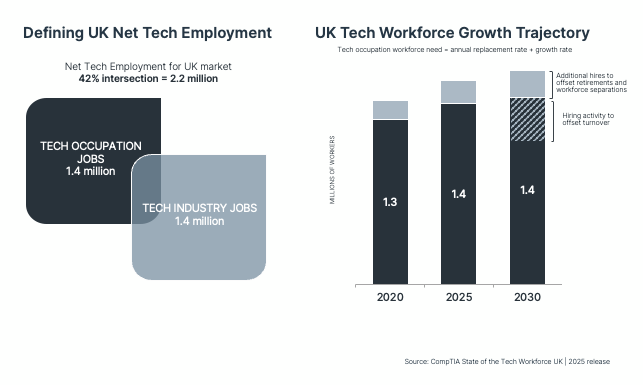
CompTIA’s projects of UK Net Tech Employment
Earning potential
In the US, the median tech salary is from $105,000 to $154,000, which is higher than the median annual wage for all occupations, according to the Bureau of Labor Statistics.
In the UK, the median tech salary varies widely but one can earn as much as £78,000 up to £90,000 for positions such as Cloud Architect, according to several job post websites. According to IT Jobs Watch, Heads of Cybersecurity can also earn over £100,000. And according to Morgan McKinley, someone in the tech industry with more than five years of experience can earn up to £140,000.
Certification ROI
Professionals with certifications in cloud computing, cybersecurity, and data management can see salary premiums ranging from 10% to 25% as per the Robert Half Salary Guide 2025. And 93% of tech professionals report having at least one certification, with benefits including improved work quality (60%), engagement (48%), and productivity (43%) according to the Global Knowledge IT Skills and Salary Report 2024-2025.
The bottom line: tech offers exceptional career stability, growth potential, and earning power. And now, it's more accessible than ever.
Can You Really Break Into Tech Without a Degree?
Yes, many tech roles don't require a degree. In fact, the industry has shifted dramatically toward skills-based hiring. What matters most to employers today is what you can do, not where you studied.
The tech hiring landscape has evolved. Companies are increasingly prioritising practical skills and certifications over formal education. For the first time, more IT workers are now employed by non-tech companies (60%) than by technology firms themselves in North America, as stated by the CompTIA State of the Tech Workforce 2025, showing just how universal tech skills have become across all industries.
Entry-level positions like IT Support Specialists, Help Desk Technicians, and Junior Cloud Administrators often require only certifications and demonstrated skills. Even more advanced roles increasingly accept certification-based credentials in place of degrees.
Bootcamps and accelerated training programs have emerged as legitimate alternatives to traditional education. These programs focus on job-ready skills and hands-on experience. Through intensive, immersive training, you can gain the same practical knowledge in weeks that might take years in traditional academic settings.
The key advantage of bootcamps is that they are designed with employer needs in mind. They teach current technologies, real-world applications, and provide the certifications that hiring managers actively seek. Just take our version of bootcamps, for example—Firebrand's accelerated training.
Partner certifications from industry leaders like AWS, Microsoft Azure, Cisco, and CompTIA are recognised globally and carry significant weight with employers.
The path is clear: choose the right certifications for your target role, complete accelerated training, build a portfolio of hands-on work, and you're ready to compete for real tech jobs.
Can You Break Into Tech Without Any Experience?
Yes, you can break into the tech industry without prior experience. Entry-level roles are specifically built for beginners, and the tech industry recognises that everyone starts somewhere. The key is understanding how to gain relevant experience quickly, even before landing your first job.
However, "experience" in tech doesn't just mean previous employment. It includes:
- Hands-on labs and projects completed during certification training
- Practice environments where you configure networks, deploy cloud resources, or troubleshoot systems
- Bootcamp work that simulates real-world scenarios
- Personal projects that demonstrate your capabilities
- Volunteer tech work for nonprofits or small businesses
Modern training is specifically designed to provide this experience. Through intensive lab work and practical exercises, you'll complete tasks that mirror actual job responsibilities.
When you finish Firebrand’s accelerated training, you don’t just learn theory. Employers would know that you have done the work because of your industry-recognised certification.
Employers are now looking for candidates who can demonstrate competency through certifications and project work, not just those who've held previous job titles. Your bootcamp projects, lab completions, and certifications prove you have hands-on experience solving real technical problems.
The key is to frame your training experience properly. Those labs you completed? That's experience in configuring systems. Those troubleshooting exercises? That's experience solving technical problems. This is legitimate, valuable experience that prepares you for entry-level roles.
What are the steps you need to take to break into tech?
Step 1: Understand the opportunities and role options in tech
Tech is a vast field with multiple career paths suited to different interests and strengths.
Here are the most accessible entry points for beginners:
IT Support / Technician
- Help users troubleshoot issues, maintain systems, and provide technical assistance
- Entry-level friendly with clear certification paths (CompTIA A+, IT Technician certifications)
Cyber Security
- Protect organisations from digital threats and ensure data security
- High demand and strong salaries, especially with companies that recognise the growing threat of AI-powered cyber attacks
- There are plenty of cyber security specialisations to choose from, so you need to find one that complements your strengths and previous experience
Cloud Engineering
- Manage cloud infrastructure on platforms like AWS, Azure, or Google Cloud
- One of the fastest-growing tech fields due to widespread cloud adoption
- Certifications like AWS Cloud Practitioner and Azure Fundamentals provide entry points
Software/App Development
- Build applications and software solutions
- High range of salary in the UK, from £60,000 to £80,000 (IT Jobs Watch)
- 15% increase in the rate of employment, until 2034, which is much faster than average (U.S. Bureau of Labor Statistics)
- Strong earning potential with average salaries around $131,000 in the U.S. (U.S. Bureau of Labor Statistics)
Data Analysis
- Analyse data to provide business insights and support decision-making
- Median salary of £65,000 to £80,000 for Data Scientist roles in the UK (IT Jobs Watch)
- Data Scientist roles projected to grow 414% from 2025 to 2035 (CompTIA Cyberstates 2025)
- Average salary of $108,000 with approximately 20,800 new openings projected annually (U.S. Bureau of Labor Statistics)
Project Management
- Coordinate tech projects and teams using methodologies like Agile and PRINCE2®
- Valuable across all industries; 2 million jobs available annually (Project Management Institute)
- PMP® certification holders earn 29% more than non-certified counterparts (Project Management Institute Salary Survey)
Each path offers distinct advantages, but all share one thing: they're accessible through certification-based training and don't require years of traditional education.
Step 2: Build the technical skills you need
Learn the fundamentals
Every tech career starts with core fundamentals. Depending on your chosen path, these might include:
- Networking basics: Understanding how systems communicate and connect
- Operating systems: Working with Windows, Linux, and command-line interfaces
- Cloud fundamentals: Basic concepts of cloud computing and services
- Security principles: Understanding threats, vulnerabilities, and protective measures
- Programming basics: Foundational coding concepts (for development roles)
These fundamentals form the foundation for all specialised tech knowledge and are typically covered in beginner-level certifications.
Learn through accelerated training
Traditional learning methods can take years. Accelerated training compresses that timeline dramatically through intensive, immersive experiences.
Firebrand's proven Lecture | Lab | Review model maximises retention and skill development:
- Lecture: Expert instructors teach concepts in focused, intensive sessions
- Lab: Immediate hands-on practice applying what you've learned
- Review: Reinforcement and testing to ensure mastery before moving forward
This immersive approach works because it eliminates the forgetting that happens with drawn-out traditional courses. You stay engaged, practice immediately, and build momentum. Students often complete certifications in days or weeks rather than months.
The accelerated model also keeps you focused and motivated. Instead of juggling learning with other commitments over months, you commit to an intensive period and emerge certified and job-ready.
Step 3: Explore certifications to boost your credibility
Certifications serve as objective proof that you possess specific technical skills. Unlike degrees that cover broad theoretical knowledge, certifications demonstrate that you can perform particular technical tasks. They're recognised globally, standardised, and trusted by employers as reliable indicators of competency.
Match your certifications to your target role:
- For IT Support/Help Desk: Start with foundational certifications that prove you can troubleshoot and maintain systems
- For Cybersecurity: Begin with security fundamentals before advancing to specialised defensive or offensive security certs. You may also check out the top Cybersecurity certificates
- For Cloud Engineering: Choose certifications specific to your preferred platform (AWS, Azure, or Google Cloud)
- For Development: Consider language-specific certifications or web development credentials
- For Project Management: PRINCE2®, PMI PMP®, or Agile certifications demonstrate that you can coordinate teams and deliver projects. Check out the top Project Management certifications
Popular beginner certifications:
- CompTIA A+: The industry-standard entry certification for IT support technicians covering hardware, software, networking, and troubleshooting
- Azure Fundamentals (AZ-900): Entry-level cloud certification covering core Azure concepts, services, and management
- AWS Cloud Practitioner: Foundational AWS certification demonstrating understanding of cloud concepts and basic AWS services
- CompTIA Security+: Entry-level security certification covering network security, compliance, threats, and vulnerabilities
- PRINCE2® 7 Project Management Foundation: Project Management methodology used globally, particularly valuable in the UK and Europe
These certifications open doors to entry-level positions and provide the foundation for advanced specialisations as your career develops.
Step 4: Build a portfolio that proves your skills
Portfolios aren't just for software developers. Every tech professional should document their work and capabilities:
- Lab snapshots and documentation: Screenshots and write-ups of systems you've configured or problems you've solved
- Networks you've configured: Diagrams and explanations of networking projects
- Cloud projects: Demonstrations of cloud deployments, architectures you've built, or infrastructure you've managed
- Security assessments: Write-ups of security audits, vulnerability assessments, or defensive configurations
- Case studies from bootcamp: Detailed accounts of your training projects showing problem-solving processes
- GitHub repositories: Even for non-developers, use GitHub to store documentation, scripts, or configuration files
- Personal website: Create a simple site showcasing your certifications, projects, and skills
At Firebrand, many of our accelerated courses include hands-on labs and projects that you complete during training. Just remember to document these projects thoroughly. They're the evidence that convinces employers you can do the work.
Your portfolio transforms "I learned about cloud computing" into "Here's a cloud infrastructure I designed and deployed." That makes all the difference.
Step 5: Build your network and find a mentor
Networking often leads directly to job opportunities. Studies show that many tech positions are filled through referrals and professional connections before they're ever publicly advertised.
Where to network as a beginner:
- LinkedIn: Connect with professionals in your target field, engage with their content, and share your learning journey
- Tech meetups and user groups: Attend local gatherings focused on specific technologies or roles
- Online communities: Join Reddit communities, Discord servers, and Slack groups focused on your area of interest
- Training fellows or cohorts: Your fellow students are valuable long-term connections in the industry
Mentorship accelerates learning and confidence
A mentor provides guidance, answers questions, and helps you navigate early career decisions. They can review your work, suggest resources, and sometimes even provide job referrals.
Leverage your course instructors as initial mentors—they're experts who understand the industry and want to see students succeed. Many maintain relationships with alumni and provide ongoing advice. Don't hesitate to ask questions and seek guidance from those who've successfully walked the path you're starting.
Step 6: Develop a strong CV (even without experience)
Place certifications prominently near the top of your resume, ideally in a dedicated "Certifications" section. List the full certification name, certifying body, and completion date. Certifications are often the first thing recruiters look for in entry-level tech resumes.
How to frame hands-on labs as real experience
Your study labs represent genuine technical work. Frame them confidently:
- "Configured and deployed cloud infrastructure in AWS, including EC2 instances, S3 storage, and VPC networking."
- "Diagnosed and resolved networking issues in simulated enterprise environments."
- "Implemented security protocols and conducted vulnerability assessments."
Emphasising soft skills
Tech roles require more than technical knowledge. Highlight:
- Communication (explaining technical concepts clearly)
- Problem-solving (approaching complex issues methodically)
- Teamwork (collaborating during bootcamp group projects)
- Adaptability (learning new technologies quickly)
These soft skills often determine success in tech roles and help compensate for limited job experience.
Step 7: Prepare for tech job interviews
Interviews for tech roles typically include multiple components:
- Technical questions: Testing your knowledge of concepts, tools, and best practices
- Practical exercises: Live troubleshooting, coding challenges, or system design discussions
- Behavioural questions: Assessing how you work, learn, and handle challenges
Review your bootcamp projects before interviews, as they provide perfect examples for answering behavioural and scenario-based questions.
How do you break into tech quickly in 3 to 6 months?
Breaking into tech in 3 to 6 months is realistic with the right approach and accelerated training. Here's a proven timeline:
Months 1 to 2: Fundamentals, Labs & Certification
- Complete an intensive bootcamp or accelerated certification program
- Focus on one core area (IT support, cloud, security, etc.)
- Pass your first certification exam
- Document all lab work and projects for your portfolio
Months 3 to 4: Portfolio Building & Networking
- Expand your project documentation
- Create a LinkedIn profile highlighting your new skills and certification
- Join tech communities and attend local meetups
- Connect with bootcamp alumni and instructors
- Begin applying to entry-level positions while continuing to learn
Months 5 to 6: Application & Interview Prep
- Apply to 10 to 20 relevant positions weekly
- Prepare STAR format stories about your bootcamp projects
- Practice technical interview questions for your target role
- Consider additional certifications to strengthen specific skills
- Follow up on applications and leverage your network for referrals
Why immersion works: Firebrand's specialty
At Firebrand, we specialise in accelerated training (similar to a bootcamp) that uses our time-tested Lecture | Lab | Review method.
Our intensive, focused courses eliminate the knowledge decay that happens with traditional part-time learning. You remain engaged, practice immediately after learning concepts, and build unstoppable momentum.
This immersive model works because it mirrors how professionals actually learn on the job through intensive, hands-on problem-solving. You'll emerge not just certified, but genuinely confident in your abilities because you've already done the work.
Ready to take the leap? Kickstart your tech career faster. With intensive, immersive training and industry-recognised credentials, you're not just learning tech—you're becoming job-ready.
Firebrand's accelerated certifications