
AI-Powered Cyber Attacks and UK Business Readiness 2026 Survey
UK organisations can clearly see where AI is amplifying existing weaknesses. Is your business prepared?
Firebrand Training's recent UK-wide survey of senior leaders across energy, financial services, retail, telecoms, professional services, and IT found that just over three-quarters or 77% believe AI is increasing cyber risk for their organisation, but only 27% are fully prepared for AI-powered cyber attacks.
Only 11% believe AI does not pose an increased cybersecurity threat, with 13% unsure, underscoring that complacency is now the exception rather than the rule.
So how exactly are UK businesses being impacted by the rising AI cyber attacks, and how are they preparing to protect themselves?
How is AI making cyber risk worse for UK businesses?
The survey shows that UK organisations are not just worried about AI in the abstract – they can see clearly where it is amplifying existing weaknesses.
When asked to quantify the impact, 38% of respondents estimate their cyber risk has risen by 10 to 49% due to AI-powered threats, and 17% believe it has gone up by 50 to 99%.
For a smaller but worrying 4%, risk has at least doubled, while 29% report no measurable increase and 13% remain unsure, suggesting that some organisations may simply not be tracking AI-related risk properly yet.
This sits against a backdrop where 47% of organisations have suffered at least one cyber-attack in the past 12 months, and 73% of those hit have experienced multiple attacks.
Financially, the impact is often severe: the most common loss bands sit between £10,000 and £199,999, and nearly half of affected organisations report total attack costs above £100,000 when including recovery, downtime, regulatory fines, and reputational damage.

What business areas are perceived to be most at risk to AI attacks?
Three areas stand out as the most exposed to AI-enabled abuse, each reflecting how attackers are using intelligence, speed, and automation to outpace traditional controls.
➤ Data Loss Prevention
Data Loss Prevention (DLP) is perceived as the single biggest area of increased risk, cited by 59% of respondents.
Here, AI can help attackers automatically discover, extract, and obfuscate sensitive data at scale, far faster than manual monitoring tools were ever designed to handle.
➤ Adversarial Tactics
Adversarial tactics, techniques and procedures come next, with 52% of leaders flagging them as an area of heightened risk.
This makes sense as AI allows threat actors to probe defences continuously, learn from failed attempts, and adapt their approaches, leading to more targeted, persistent campaigns that are harder to spot with rule-based tools.
➤ Social Engineering
Social engineering is also being reshaped by AI, with 41% of respondents worried about AI-fuelled manipulation.
From highly convincing deepfake voice calls and synthetic video to hyper-personalised phishing at scale, AI is making it far easier to attack people rather than infrastructure and many UK workers still lack training to recognise AI-generated content.
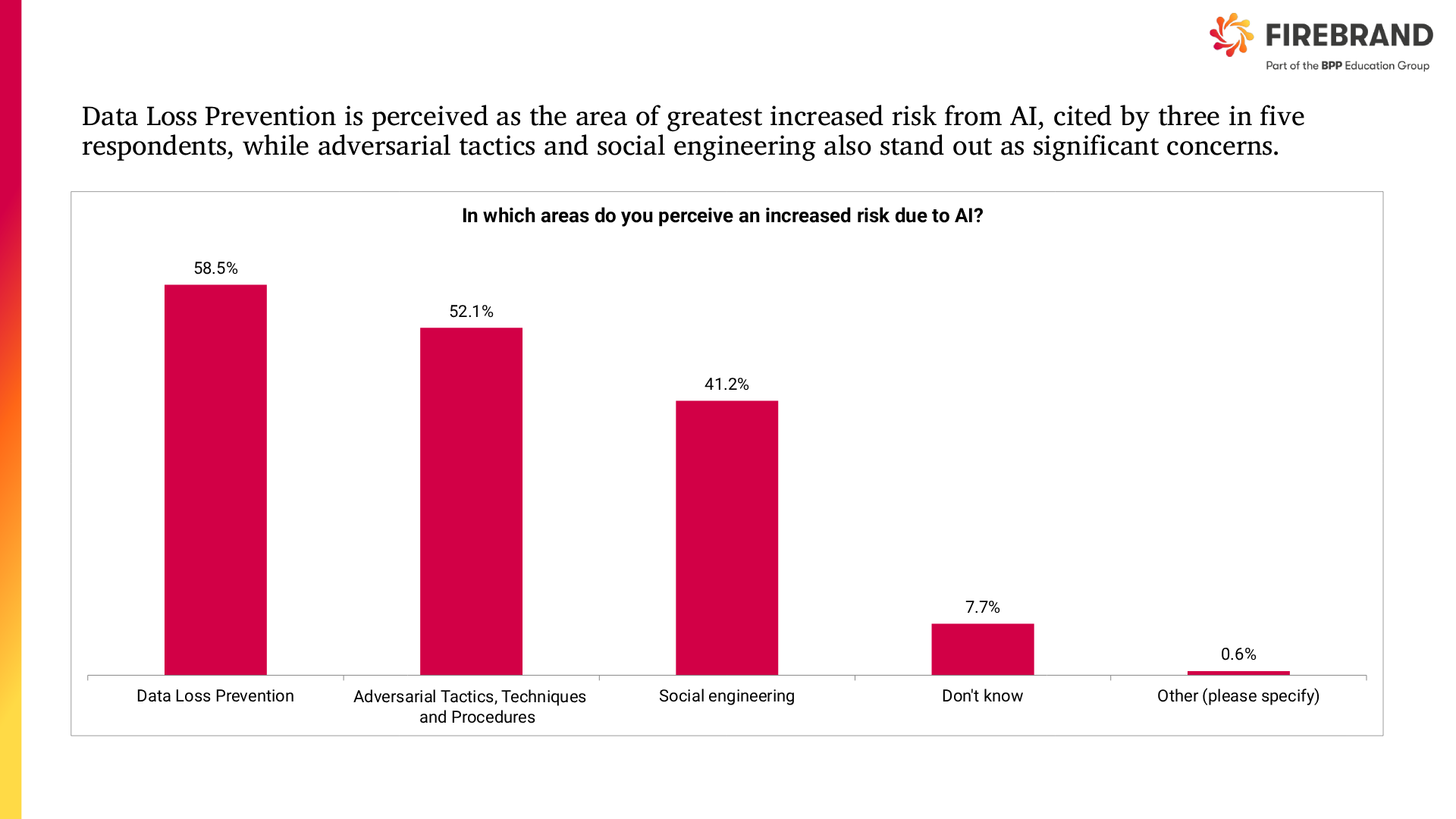
Firebrand Survey on Cyber Attacks, 2026
How prepared are UK cybersecurity teams for AI-powered attacks?
Despite this high level of concern, most organisations admit they are not fully ready to face AI-driven threats.
When asked if their teams are specifically trained to respond to AI-driven cyber threats, only 27% say yes, fully, while 56% report that they are only somewhat trained.
Alarmingly, 12% of organisations state that their teams are not at all trained for AI-driven threats, and 5% are not sure about their status, revealing a long tail of unpreparedness.
This means that roughly seven in ten organisations are operating with partial or no AI-specific readiness, despite clear recognition of the risk.
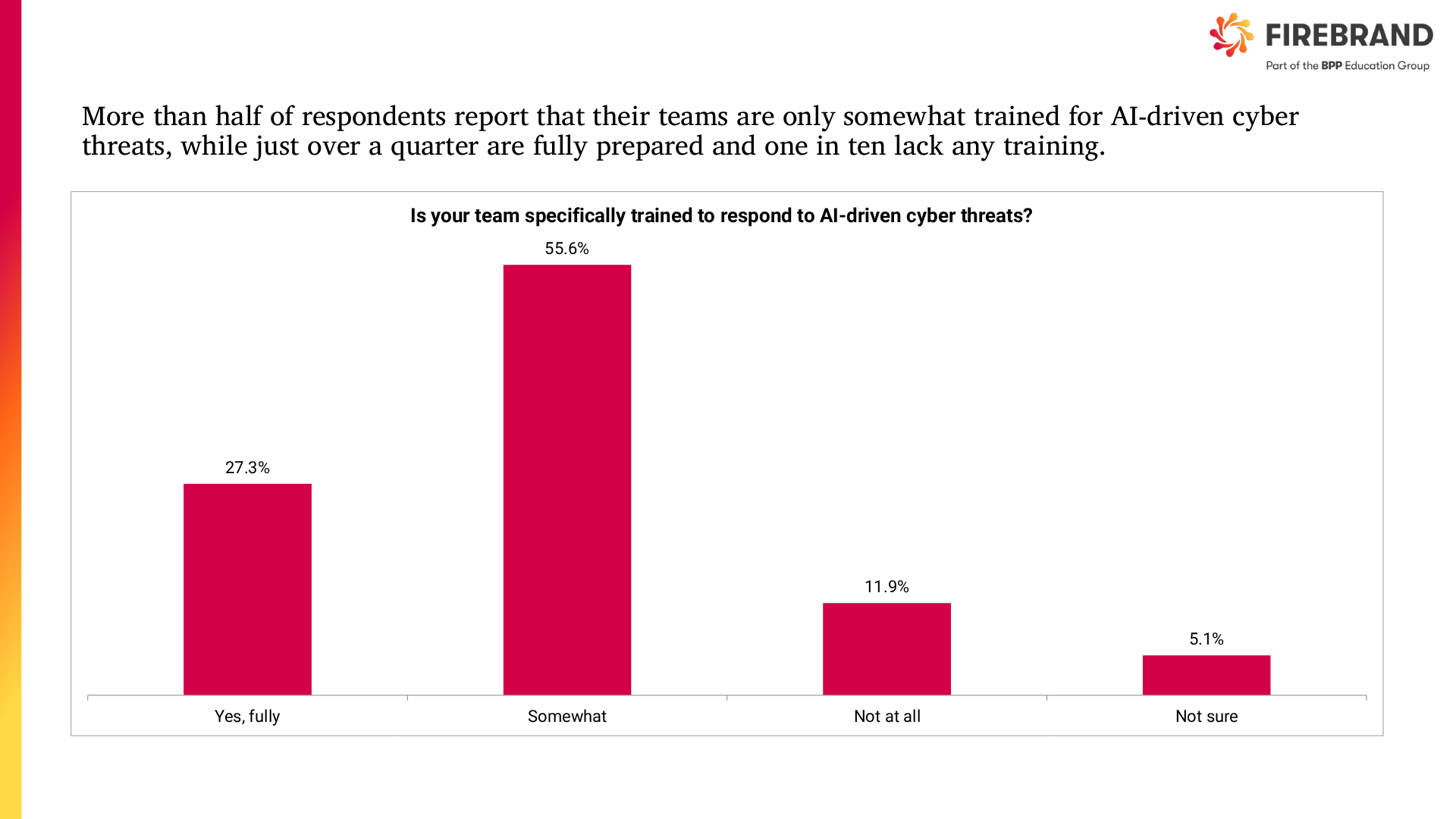
UK business readiness for AI attacks, 2026
This readiness gap sits alongside more general capability and skills issues.
Across the sample, cybersecurity team sizes cluster in the mid-range, with around a third reporting teams of 10 to 24 people, but larger teams do not automatically translate into AI-specific capability.
On the certification side, 47% of respondents say their cyber teams are fully certified in industry-recognised frameworks such as ISC2 Certified Information Systems Security Professional® (CISSP®), ISACA Certified Information Security Manager® (CISM®), or CompTIA Security+, while 36% have partial certification coverage and a worrying 16% have none.
What are UK organisations currently doing to respond to AI-related cyber risks?
Most organisations are not standing still. They are taking a range of actions to respond to rising AI-related risk.
However, the data suggests that many responses are incremental rather than transformational, and may not yet match the speed at which attackers are innovating.
The most common response is to increase training, with 73% of organisations taking this step.
This is followed by updating policies (64%) and adopting new tools and technologies (56%), suggesting that governance and tooling are evolving in parallel.
Only 30% of organisations have hired new talent to address AI-related risks, indicating that many are attempting to upskill existing teams rather than bring in dedicated AI-security expertise.
A small but concerning 7% say they have taken no action yet on AI-related cyber risks, leaving themselves particularly exposed as threat actors experiment aggressively with AI.
This pattern reflects a wider picture across the UK where firms are increasing cybersecurity spending and prioritising AI, but execution and maturity often lag behind ambition.
The survey findings suggest that while UK companies are moving in the right direction, actions are not yet at the scale or specificity required for AI-era threats.
Does cyber security training actually work and what does it mean for AI threats?
The good news is that training and certification demonstrably reduce cyber risk in general.
Among organisations that have implemented ongoing certification training, 86% report a reduction in their risk of cyber-attacks, with 38% seeing a significant reduction and 48% seeing a more modest but still positive impact.
Firebrand Training partners with companies and enterprises of all sizes and have seen this change and readiness firsthand.
“Ensuring your team is fully equipped and trained to counter AI-powered cyber attacks is something you cannot put off. The sooner you invest in this capability, the faster you'll achieve genuine peace of mind and operational resilience,” says Firebrand's Cybersecurity Subject Matter Expert, Phil Chapman.
“We consistently see leaders operate with greater confidence when they know their cyber security capability is robust and professionally managed. A fully trained and certified team also sends a clear signal to customers and partners that your organisation is a safe, secure and trustworthy business to work with,” Phil added.
Crucially, 65% of respondents say they can actually quantify that reduction, and across those who can, the average reduction in risk is 47.58%.
Almost half (47%) of this group report a risk reduction of more than 50%, showing that well-structured training and certification programmes can deliver major defensive gains.
These risk reductions translate directly into business outcomes.
When asked about the most significant benefit from reduced risk, 32% highlight fewer successful attacks, 30% point to faster incident response, 19% report reduced downtime, and 17% cite improved audit and compliance results.
How can UK companies close the AI cyber readiness gap?
If awareness is high and training has a proven track record, the obvious question is: what should UK organisations do next to become truly AI-ready?
The survey data, combined with emerging best practices, points towards a focused set of priorities that move beyond generic controls to explicitly address AI-powered threats.
➤ Include AI-specific content into cyber training across organisations
First, organisations need to move from “somewhat trained” to scenario-ready by embedding AI-specific content into cyber training and simulations.
That means red-teaming AI-generated phishing, deepfake-enabled fraud and automated data theft, and ensuring incident response playbooks explicitly cover these use cases rather than treating them as edge cases.
➤ Invest in AI-native defensive tools
Security leaders should invest in AI-native defensive tools, not just bolt-on point solutions.
With companies already adopting new tools and technology, the next step is to ensure that these systems use machine learning for behavioural analytics, anomaly detection and rapid triage, effectively pitting defensive AI against offensive AI.
➤ Prioritise data loss prevention
There is a clear need to prioritise Data Loss Prevention and identity-centric controls.
Organisations should tighten data access paths, monitor unusual movement of sensitive data and add stronger verification for high-risk actions, particularly in finance, payments and critical operations.
➤ Address talent and governance gap
Companies should address the talent and governance gap, not just the tooling gap.
While some businesses prefer to hire new talent, more money is spent in this regard compared to upskilling current staff.
Of course, this should be done alongside updating policies to reflect AI risks in procurement, vendor management and third-party integrations.
AI attacks readiness as an ongoing project
Boards and executives need to treat AI cyber readiness as a continuous capability, not a one-off project. This is because AI by principle learns continuously and AI trained to hack means it can adapt faster. Learning becomes a never-ending process for teams.
This must become a strategic priority for 2026 and beyond if UK organisations want to stay ahead of rapidly evolving AI-powered attackers.
Robust certification of cybersecurity teams
Don't leave your organisation exposed to AI-powered cyber attacks. Firebrand Training's accelerated certification courses — delivering CISSP®, CISM®, and CompTIA Security+ in weeks, not months — equip your teams with the specialist skills proven to cut cyber risks.
UK businesses trust our intensive, exam-pass guaranteed programmes to close readiness gaps fast, with 86% of certified teams reporting measurable risk reduction.
Contact Firebrand today to secure your place on the next course and transform "somewhat trained" into AI-ready defences before attackers strike.