
The Hidden Cost of Cyber Attacks: Why Recovery Time and Team Strain Matter More Than Ransom Demands
Cyber attacks often grab headlines with ransom demands and fines, but the true hidden cost of cyber attacks lies in operational disruption and human toll.
Our 2026 survey of UK senior leaders reveals that internal IT and security teams bear the brunt, with downtime and productivity losses hitting nearly half of affected organisations.
How many UK companies faced a cyber attack in 2025?
Let’s look at the topline statistics first: 47% of organisations faced a cyber attack in the past year, with 73% experiencing more than one. This is no surprise given that AI-powered cyber attacks are also on the rise.
Financial impacts averaged £10,000 to £199,999 per incident for most, but the real sting comes from overlooked areas like recovery time and team strain.
This operational drag – not just pounds paid – compounds with every breach, eroding resilience over time.
What is the hidden cost of cyber attacks and incidents in the UK?
Costs don’t just mean fines and ransom demands. When leaders discuss the cost of cyber incidents, focus typically falls on direct financial hits such as ransoms, regulatory fines, or lost revenue.
Yet our UK survey across energy, finance, retail, telecoms, professional services and IT sectors shows a different picture.
Strain on Internal IT and Security Teams
Firebrand's survey pinpoints internal IT and security teams as the most impacted resource, cited by 54% of respondents after cyber attacks. These teams, often sized 10 to 24 members (32% of organisations), face relentless demands during incidents, diverting them from strategic work.
Financial losses (50%) and downtime (46%) follow closely, but the human pressure on IT/security creates lasting bottlenecks.
Burnout and retention risks
Cyber attacks thrust IT and security teams into "war room" overdrive. Repeated incidents breed fatigue, as 73% of affected firms endured multiple attacks in 12 months.
Burnout risks rise, eroding expertise when staff depart post-breach. Despite 68% having ongoing training, skills gaps persist in 41%.
Beyond IT, 42% saw productivity dips across staff. Manual workarounds frustrate operations and customer service teams, sparking "breach fatigue" where staff dread recurring chaos.
Morale plummets as finance scrambles on unexpected costs and leadership faces internal scrutiny. This breeds disengagement, with surveys like ours highlighting how eroded trust in systems lowers retention and productivity long-term.
Downtime, lost productivity, and broken momentum
Temporary business downtime affected 46% of hit organisations, with employee productivity losses (access issues, manual processes) impacting 42%. Recovery from the most recent successful attack took less than a week for 71%, but 1 to 3 days (27%) or 4 to 7 days (27%) still meant significant disruption.
This lost momentum delays projects such as cloud migrations or upgrades, trapping firms in reactive cycles.
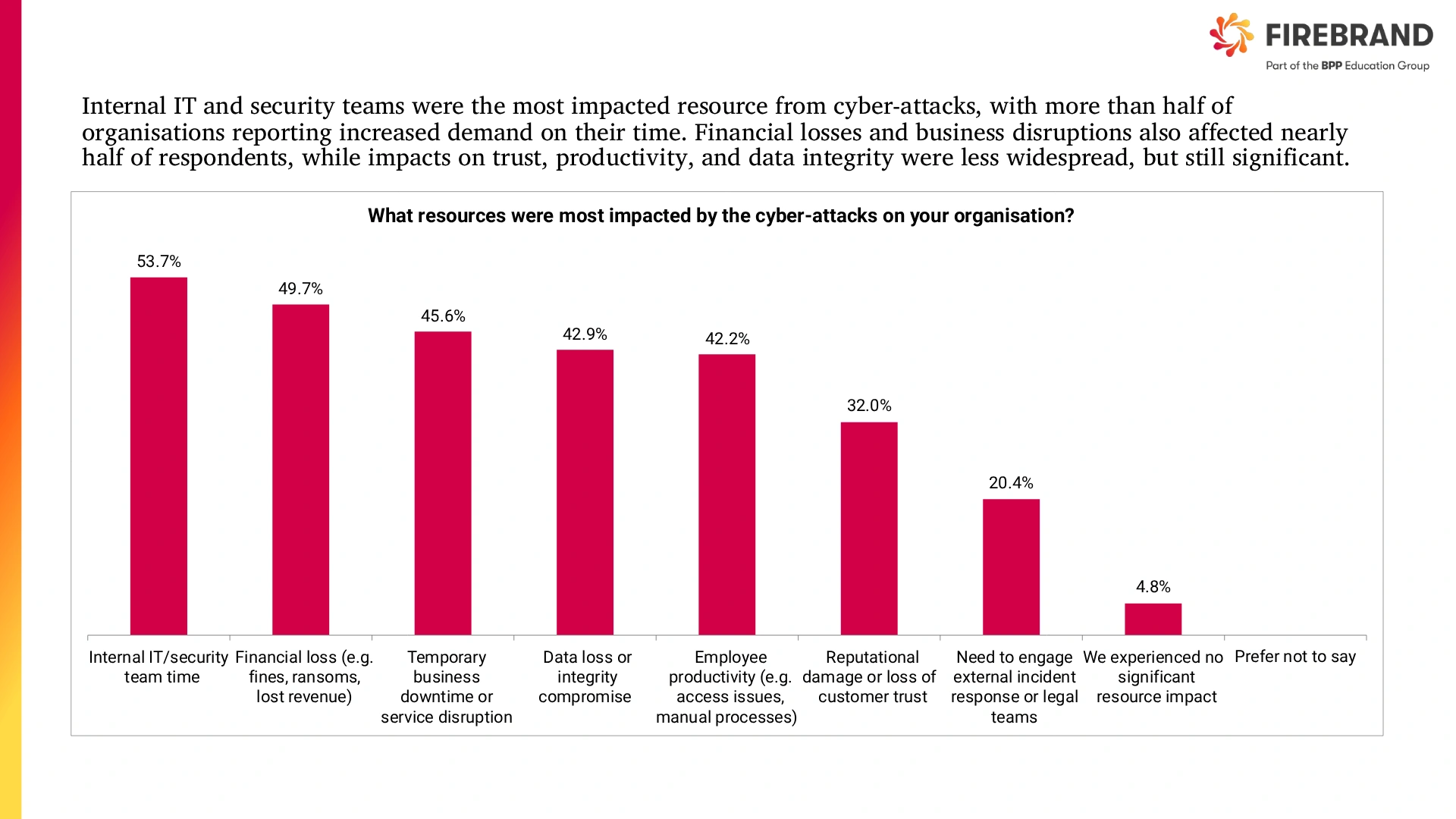
The strain on teams is widespread after a cyber attack, Firebrand UK Survey 2026
Project delays and backlogs
Incident recovery pulls talent from roadmaps, with external response needs hitting 20%. Because the company is focused on putting out fires, other projects could be put on the back burner or, at least, there would be disruption.
Reputational risks and loss of trust
Data breaches expose sensitive customer information, triggering public backlash, media scrutiny, and regulatory probes under UK GDPR. In short, these headlines erode brand equity. Retail and financial services sectors from our survey were especially vulnerable, with trust loss compounding financial hits of £10k to £199k.
What else can happen as a result? Customers switch providers post-breach while partners reassess contracts, creating revenue gaps that linger for years. This invisible erosion demands proactive monitoring and transparency plans.
Hidden costs that compound over time
| Hidden Cost Category | % Affected (Survey) | Impact |
| IT/Security Team Time | 54% | Overtime, diverted projects |
| Downtime/Productivity Loss | 46–42% | Paused sales, backlogs |
| Staff Turnover Risk | Indirect (skills gaps 41%) | Recruitment, lost knowledge |
| Reputational Damage | 32% | Customer churn |

How can companies become cyber resilient?
Traditional cyber defence fixates on thwarting attacks or minimising payouts like ransoms and fines, but Firebrand's survey underscores a smarter pivot: resilience measured by swift operational recovery and team wellbeing. Strengthening cyber readiness is now a must.
This shift addresses the hidden cost of cyber attacks by targeting downtime and human strain head-on, breaking the cycle of repeated disruptions.
Our UK survey benchmark shows 71% of organisations recover fully within a week from successful cyber attacks, yet 27% take 1 to 3 days and another 27% need 4 to 7 days. Prioritise metrics like mean time to recover (MTTR) over mere detection, aiming to beat this benchmark through:
- Rehearsed playbooks and tabletop exercises to streamline decision-making
- Automated backups, immutable storage and regular testing for rapid restoration
- Clear escalation paths with predefined roles (e.g., IT lead, CISO, external counsel)
- Chaos engineering drills to simulate breaches in safe environments
Don’t let the skills gap prevent your company from being protected. Ongoing certification training delivers tangible gains: 86% of respondents report reduced cyber risks, with an average 47% drop in vulnerability, translating to faster incident response (30% cited as a top outcome) and less downtime (19%).
How do you protect IT teams from burnout?
With surveyed firms reporting maximum strain on internal IT and security teams, these unsung heroes face overtime, cancelled leave and perpetual fire-fighting. Counter this with structured measures:
- Proper staffing: On-call rotations with mandatory downtime (e.g., 8-hour shifts max, 48-hour breaks). Skills cross-training to distribute load and build team depth.
- Organise response partners: Pre-arrange external incident response partners (e.g., MDR providers) for surge capacity.
- Debriefs and post-mortems: Post-incident debriefs using structured frameworks like blameless post-mortems.
- Mental health support: EAP access, counselling sessions and resilience workshops.
- Wellness incentives: Flexible hours post-incident, gym subsidies or team-building retreats.
- Regular check-ins: Track fatigue via anonymous pulse surveys, ensuring expertise stays in-house amid 41% reporting skills gaps.
- Certification and upskilling: Achieving top cybersecurity certifications fortifies resilience and improves the team’s confidence to handle incidents. 47% of teams are fully certified in frameworks like CISSP or CISM, with another 36% partially so, directly boosting response speed and confidence.
How does Firebrand reduce the risk of cyber attacks and their hidden costs?
As your dedicated training partner, Firebrand Training empowers UK organisations to close critical cybersecurity skills gaps, retain top talent and build certified teams that deliver faster recovery and resilience, directly mitigating the hidden cost of cyber attacks like team strain and downtime.
Since 2001, we've trained over 135,000 IT professionals, saving employers more than one million hours through accelerated, immersive learning with 97% satisfaction and superior first-time pass rates.
Building confident, practised incident responders
Firebrand's accelerated courses target the skills gaps in incident response and infrastructure security from our UK survey, using our proven ‘Lecture – Lab – Review’ model to turn theory into field-ready practice.
Empowering UK organisations to break the cycle
Firebrand aligns training with business strategy via needs analysis, helping leaders quantify post-training risk drops and retain talent amid IT strain. Flexible enterprise solutions maximise ROI while keeping teams productive.
Tailored options:
- Firebrand Passport: Save up to 20% on scalable training across teams, with exclusive corporate rates.
- Bespoke Training: Custom courses for your tech stack, IR35-compliant and global delivery for sectors like finance or energy.
- Microsoft Unlimited: Six months of unlimited Microsoft certs (e.g., security, Azure) at one price for broad upskilling.
- Firebrand Membership: Tiered perks—prioritised support, points for rewards—as your team advances.
- Onsite/Online Delivery: Focus-built venues or virtual, minimising time away (up to 12-hour days of labs).
Request a free training needs analysis today to audit gaps and safeguard your teams