
Why Banks Are Particularly Vulnerable to AI-Powered Cyber Attacks
Due to AI threats, banks are entering a new era of cybersecurity regulation.
Banks have always been attractive targets for cybercriminals. Of course, they deal with money and customer data — two things that hackers and criminals want the most.
As banks continue to embrace things like open banking and interconnected third-party ecosystems, the opportunities for attackers have grown significantly with the help of artificial intelligence.
Because of this, banks are entering a new era of cybersecurity regulation. In July 2026, the European Central Bank (ECB) wrote to chief executives of significant financial institutions, warning that advances in artificial intelligence are fundamentally changing the cyber threat landscape.
Rather than treating AI-enabled attacks as an emerging risk, the ECB is now asking banks to demonstrate how prepared they are to defend against them, requiring institutions to assess their exposure and submit a comprehensive action plan. And though this is happening in Europe, financial regulatory bodies in other parts of the world are expected to follow this example.
This article will tell you what you need to know about AI-powered cyber attacks in the banking industry and what you need to do to be prepared and compliant with new regulations.
What are the latest cyber attacks on the banking and financial industry?
Firebrand's own survey of senior decision-makers across UK organisations found that nearly half (47%) experienced a cyber attack in the past 12 months. More concerning still, almost three-quarters (73%) of those organisations suffered multiple attacks, demonstrating that cyber threats are no longer isolated events but an ongoing operational challenge. Though these figures are not focused on the banking industry alone, they are still concerning.
In March 2026, Reuters reported that US banks were on heightened alert for cyberattacks as geopolitical tensions escalated, with disruptive campaigns such as DDoS remaining a concern.
In June 2026, there were reports of Android malware targeting 217 banking and cryptocurrency apps, showing how quickly attackers adapt to mobile banking and digital payment environments.
How AI-powered cyber attacks target banks and their customers
The frightening thing is that AI is making these attacks harder to spot. Criminals are using AI to produce more convincing phishing messages, imitate legitimate banking language, and automate reconnaissance at scale. AI is also intensifying fraud through voice cloning, deepfakes, and synthetic identities, which makes impersonation attacks more difficult for staff and customers to detect.
At the same time, banks are adopting AI for detection and fraud prevention, so the sector is now facing a race between defensive AI and offensive AI.
| Threat category | How AI attacks banks and financial institutions | How AI attacks customers |
| AI phishing & social engineering | AI generates highly convincing phishing emails impersonating executives, regulators, suppliers or colleagues to steal employee credentials, deploy malware or gain access to internal systems. | Customers receive personalised emails, SMS messages and fake banking alerts that closely resemble legitimate communications, making scams significantly harder to identify. |
| Business Email Compromise (BEC) | AI mimics executives' writing styles and internal communications to trick finance teams into authorising fraudulent payments or changing supplier bank details. | Customers may receive convincing requests to transfer funds or "verify" account information, believing the request came from their bank. |
| Voice cloning & deepfakes | Criminals clone the voices of senior executives or create deepfake videos to bypass internal approval processes, manipulate staff or gain unauthorised access. | Fraudsters impersonate bank employees or trusted family members, convincing customers to disclose one-time passcodes, banking credentials or authorise payments. |
| Identity fraud & synthetic identities | AI creates realistic fake identities to bypass Know Your Customer (KYC) processes, open fraudulent accounts or apply for loans and credit. | Stolen personal information is combined with AI-generated data to commit identity theft, leaving victims to resolve fraudulent accounts or damaged credit records. |
| Credential theft & account takeover | AI automates credential stuffing and password attacks against employee accounts, VPNs and administrative systems using stolen credentials from previous breaches. | Customers who reuse passwords across multiple services are vulnerable to account takeover, enabling criminals to access online banking and payment platforms. |
| AI-assisted malware & ransomware | AI accelerates malware development, identifies critical banking systems and helps ransomware operators maximise operational disruption before demanding payment. | Banking apps and personal devices can become infected with malware that steals credentials, intercepts authentication codes or locks users out of their accounts. |
| Reconnaissance & vulnerability discovery | AI rapidly scans internet-facing systems, cloud infrastructure and third-party software to identify exploitable weaknesses before defenders can respond. | While largely invisible to customers, successful reconnaissance often leads to data breaches that expose personal and financial information. |
| Fraud detection evasion | Attackers use adversarial AI techniques to manipulate fraud detection models, allowing malicious transactions to appear legitimate. | Fraudulent payments may evade detection systems, increasing the likelihood of customers suffering financial losses before suspicious activity is identified. |
| Supply chain & third-party compromise | AI helps attackers identify weaker suppliers, fintech partners or managed service providers to gain indirect access to banking environments. | Customers can be affected even when their own bank is not directly compromised, as attacks on trusted third parties may expose personal data or disrupt services. |
| Operational disruption | AI-powered attacks, including ransomware and distributed denial-of-service (DDoS) campaigns, can disrupt payment systems, online banking and critical business operations. | Customers may experience delayed payments, inaccessible accounts, unavailable digital banking services or reduced access to customer support during incidents. |
Why are banks increasingly vulnerable to AI-powered cyber attacks?
What once required skilled attackers, significant planning and considerable resources can now be automated and executed at scale targeting the financial industry and its customers.
This growing concern is reflected in Firebrand's research. More than three-quarters (76%) of organisations believe AI has increased their cybersecurity risk, while over a third reported that AI-powered threats have increased their risk by between 10% and 49%. Respondents identified Data Loss Prevention, adversarial tactics and social engineering as the areas most affected by AI.
For banks, where trust and accuracy underpin every customer interaction, even a single successful AI-enabled attack can have far-reaching consequences.
Banking employees remain one of the biggest attack surfaces
Cybersecurity is no longer solely a technology challenge… it is increasingly a people challenge.
Banking professionals operate in high-pressure environments where speed is critical. Customer service teams, fraud analysts, compliance officers, operations specialists and IT teams process thousands of decisions every day. Attackers understand this and deliberately exploit routine workflows, urgency and trust.
AI has made phishing campaigns significantly more convincing. Criminals can now generate emails that accurately imitate internal communications, regulatory notices or customer requests. Combined with voice cloning and deepfake technologies, social engineering attacks are becoming increasingly difficult to identify using traditional awareness alone.
As AI lowers the barrier to launching sophisticated attacks, organisations must ensure their employees are equipped to recognise evolving threats rather than relying solely on technical controls.
A growing digital ecosystem creates more opportunities for attackers
Modern banks depend on an extensive network of cloud providers, payment processors, fintech partners, software vendors and managed service providers. While these partnerships enable innovation, they also expand the organisation's attack surface.
Every integration represents another potential entry point. Weak identity management, inconsistent supplier security standards or compromised third-party credentials can all provide attackers with access to critical systems.
The challenge becomes even greater as banks continue adopting AI-powered tools and automation platforms, many of which require access to large volumes of sensitive organisational and customer data.
Cybersecurity skills gaps are becoming a strategic business risk
Technology can only be as effective as the people responsible for deploying, managing and responding to it.
Firebrand's research found that 41% of organisations acknowledge gaps in their cybersecurity skills and knowledge, with the most common weaknesses relating to risk controls, information security and incident response.
These capability gaps have significant implications for financial institutions.
Security teams that lack specialist expertise may take longer to detect attacks, investigate incidents or recover compromised systems. As attackers increasingly leverage AI to automate reconnaissance and accelerate exploitation, defenders must also continually develop their skills to keep pace.
What are the costs of AI cyber attacks to the banking and financial industry?
The immediate financial impact of a cyber attack rarely reflects its true cost. In 2024, the average cost of a data breach in the financial sector reached USD 6.08 million.
Firebrand's survey found that many organisations incurred losses ranging from tens of thousands to hundreds of thousands of pounds following successful attacks, while almost one in ten experienced costs exceeding £1 million.
Beyond direct financial losses, there are also hidden costs to these attacks. Organisations reported significant impacts on:
- internal IT and security teams
- business disruption
- operational downtime
- employee productivity
- data integrity
- customer trust and reputation
But the true impact extends far beyond immediate financial losses. Cyber incidents can disrupt operations, damage customer trust, attract regulatory scrutiny and delay strategic transformation programmes.
Recovery costs often divert investment away from digital transformation and customer experience improvements. They also take away time from innovation initiatives while increasing regulatory scrutiny and operational risk.
Operational resilience has become a competitive advantage
Customers expect uninterrupted access to digital banking services. Even relatively short outages can delay payments, interrupt trading activities, overwhelm contact centres and damage confidence.
The survey found that although most organisations recovered from their most recent cyber incident within a week, recovery still required significant operational effort and business disruption.
Resilience therefore depends on more than preventing attacks. Banks must also develop the capability to detect threats quickly, respond effectively and recover with minimal disruption.
This requires strong incident response planning, tested recovery procedures, business continuity exercises and skilled cybersecurity professionals capable of operating under pressure.
Continuous cybersecurity training is one of the strongest defences
All of these may seem overwhelming, but the good news is that continuous professional development enables cybersecurity teams to stay current with emerging attack techniques and regulatory requirements.
Firebrand's research demonstrates the measurable value of investing in people. Nearly seven in ten organisations already operate ongoing cybersecurity training programmes, while a further 24% plan to introduce one.
Among organisations providing ongoing certification training:
- 86% reported that certification had reduced their cybersecurity risk
- nearly two-thirds had measured that improvement
- the average reported reduction in cyber risk was almost 48%
- the most common business outcomes were fewer successful attacks and faster incident response.
These findings reinforce what many security leaders already recognise: investing in cybersecurity skills is a necessity and not a nice-to-have.
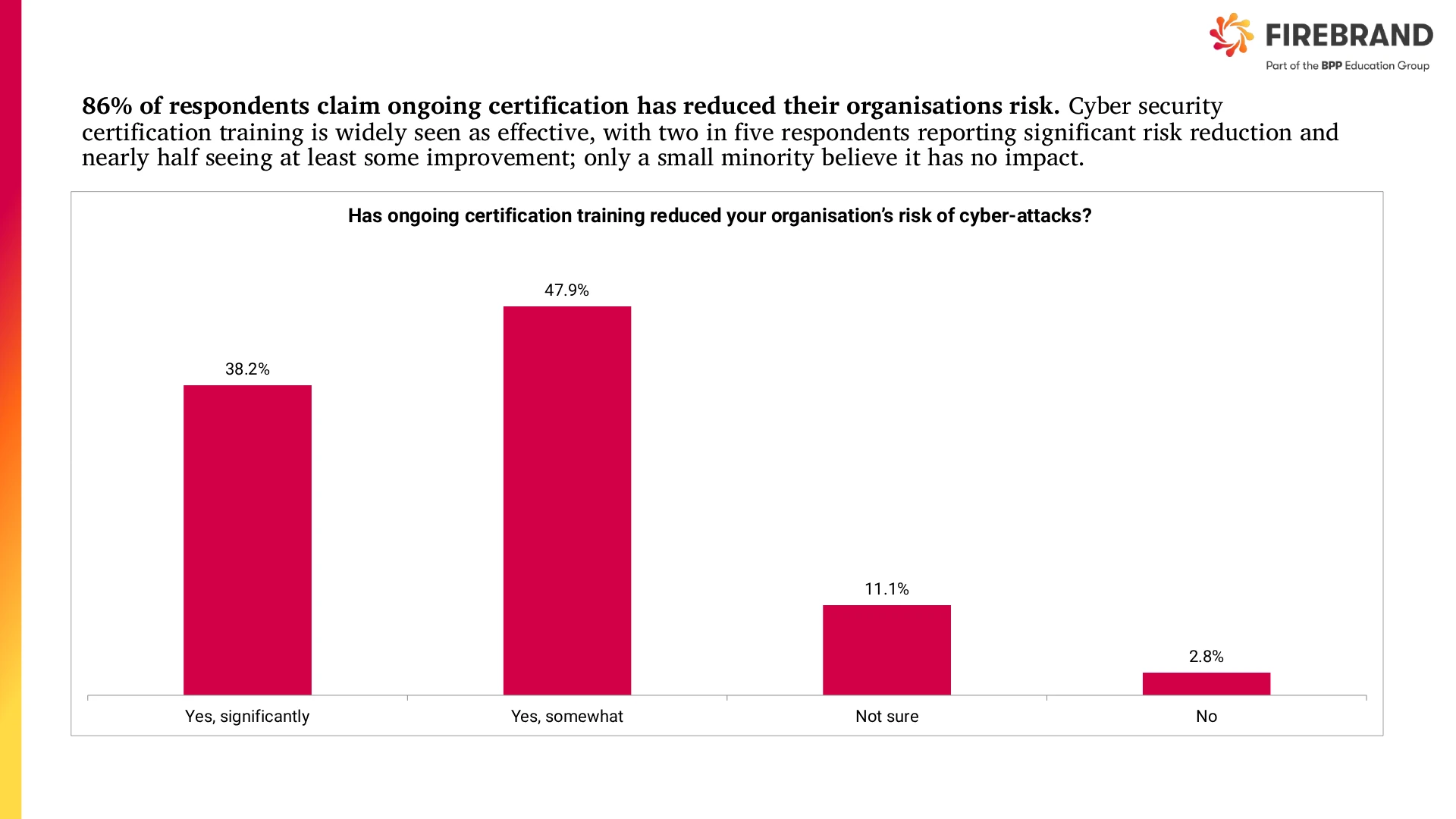
From the Firebrand UK survey of industry leaders: Reduced risks with training
Ensuring compliance with financial regulatory bodies
The ECB's latest communication sends an unmistakable message: AI-enabled cyber threats are a supervisory priority.
While technology investments remain essential, many of the ECB's expectations depend on having people with the knowledge and practical expertise to implement them. Strengthening vulnerability management, improving cloud and infrastructure security, enhancing incident response, governing AI securely and building operational resilience all require highly skilled teams that can respond confidently as threats evolve.
This is where continuous professional development becomes a strategic advantage rather than simply a compliance exercise. Firebrand helps financial institutions build the technical capabilities required to meet today's cybersecurity challenges through accelerated, hands-on training and industry-recognised certifications aligned to cloud security, identity management, incident response and cyber resilience.
The Firebrand Advantage
Whether your priority is preparing Security Operations Centre (SOC) analysts to respond to AI-powered attacks, upskilling cloud engineers to secure increasingly complex environments, strengthening governance and risk capabilities, or equipping security leaders with advanced certifications, Firebrand helps organisations build the expertise needed to improve resilience across the entire technology function. We call it the Firebrand advantage.
What sets Firebrand apart is its accelerated learning approach. Its proven Lecture | Lab | Review methodology combines expert instruction with immersive, hands-on labs and structured reinforcement, enabling professionals to develop practical, job-ready skills in significantly less time than traditional training.
Firebrand’s portfolio includes more than 1,500 courses across cyber security, cloud, AI, infrastructure, governance and risk management, delivered through globally recognised certifications from vendors including Microsoft, ISC2, ISACA, AWS, Cisco, EC-Council and CompTIA.
For organisations investing at scale, Firebrand acts as a long-term strategic training partner rather than simply a course provider. By working closely with technology and learning leaders, Firebrand helps organisations assess capability gaps, map training to transformation programmes, create scalable learning pathways and ensure new skills can be applied in role from day one.
With industry-leading learner satisfaction, above-average first-time pass rates and the Firebrand Certification Guarantee, organisations can invest in workforce development with confidence.