
What Security Teams Need to Know About AI Attacks in the Manufacturing Industry
Manufacturing was the most targeted industry for the fourth consecutive year, accounting for 26% of incidents among the top ten targeted industries, IBM report
Like any other industry, manufacturers are adopting AI to improve their operations. This includes predictive maintenance, quality inspection, inventory management, process optimisation and supply-chain planning.
However, the same technologies are helping cyber criminals create more convincing phishing messages. In other cases of AI-powered cyber attacks, it is also used to impersonate trusted people, automate reconnaissance and target valuable operational data.
For security teams, the concern is not only data loss. A successful attack can disrupt production, delay shipments, expose intellectual property, affect product quality and create safety risks.
AI therefore needs to be treated as both a cybersecurity issue and an operational-resilience issue. Here are important things that cybersecurity teams need to know about AI-powered attacks targeting the manufacturing industry.
What is the threat of AI to the manufacturing industry?
Manufacturing remains a high-value target because even short periods of downtime can have significant financial and operational consequences.
IBM reported that manufacturing was the most targeted industry for the fourth consecutive year, accounting for 26% of incidents among the top ten targeted industries in IBM’s 2025 Threat Intelligence Index.
The cost of disruption can be severe:
- The average total cost of a data breach in the industrial sector was USD 5.56 million in IBM’s Cost of a Data Breach report, which is 13% above the global average.
- The industrial sector’s average breach cost increased by USD 830,000 year on year, the largest increase across industries in that report.
- IBM also cited an estimated loss of USD 22,000 per minute when an automotive production line stops.
- Malware appeared in 40% of those industrial-sector incidents, with ransomware accounting for 30% of malware deployments.
These figures do not mean every manufacturing attack uses AI. However, they show why AI-enhanced phishing, identity attacks, fraud and ransomware deserve urgent attention: they can turn a familiar cyber weakness into a production, safety or supply-chain crisis.
Why is manufacturing a prime target?
Manufacturers have time-sensitive operations. Attackers understand that production disruption can create intense pressure to restore systems quickly, which makes extortion more effective.
Manufacturing organisations are attractive targets because they often have valuable intellectual property, including product designs, process data and supplier information. They also have interconnected supply chains where disruption at one plant can affect customers, partners and distributors.
In some cases, factories may also use legacy OT equipment that may be difficult to patch, replace or monitor. And in other cases, there could also be remote access for maintenance teams, equipment vendors and third-party providers.
These different access points can be exploited for their vulnerabilities, especially if teams are not well-equipped to respond quickly.
Unfortunately, in countries like the UK, there is still a huge cybersecurity gap across different industries. And in a business readiness survey conducted by Firebrand, only 27% were confident enough to say that they are fully prepared for an AI-powered attack.
What are examples of AI cyber attacks on the manufacturing industry?
AI does not replace conventional cybercrime. It makes familiar attacks faster, more tailored and harder for people to spot. Here are several examples:
AI-Enhanced Phishing and Deepfake Fraud
Attackers can use generative AI to create well-written phishing emails that match a supplier’s tone, a plant manager’s responsibilities, or a finance team’s workflow. They can also use voice cloning or manipulated video to imitate executives, engineers or vendors.
A typical scenario might involve a fake urgent call from a senior executive requesting a payment, a supplier bank-detail change or access to production information. The message may appear credible because the attacker has used public information, breached data or social engineering to make it specific.
The control is not simply “spot the deepfake”. Security teams should help finance, procurement and plant leadership establish independent verification procedures for high-risk requests.
Faster Reconnaissance and Credential Attacks
AI can help attackers process large volumes of public information, leaked credentials, exposed services and organisational data. This makes it easier to identify likely entry points, trusted contacts and vulnerable workflows.
Security teams should assume that exposed remote-access services, reused passwords, weak multi-factor authentication coverage and over-privileged accounts will be found quickly.
AI-Assisted Ransomware Operations
Ransomware remains one of the most damaging threats to manufacturing because it can stop business systems, disrupt scheduling and create pressure to restore production.
AI may support attackers by speeding up social engineering or improving malicious content.
The important point is practical. Treat identity compromise, phishing and unauthorised remote access as potential ransomware precursors. Do not wait for encrypted files or a ransom note before escalating.
Attacks on Manufacturing AI Systems
AI systems deployed in factories can become targets themselves. Attackers may attempt to manipulate inputs, corrupt training data, exploit insecure application programming interfaces, compromise cloud connections or misuse overly powerful AI integrations.
Something like data poisoning can also happen when an attacker manipulates data. And when this happens, AI models produce unreliable or harmful outputs. In manufacturing, this could affect quality inspection, predictive maintenance, inventory forecasting or process optimisation.
Guidance on AI in OT advises organisations to include adversarial inputs and data poisoning in their threat models, and to monitor models for anomalous behaviour or manipulation attempts.
Manufacturing Assets Most at Risk
| Asset or environment | Likely AI-enabled threat | Potential impact |
| Corporate email and IT | AI-written phishing, credential theft, ransomware | Business disruption and a route towards OT. |
| Remote access systems | Targeted credential attacks and supplier impersonation | Unauthorised access to industrial environments. |
| OT networks | Compromised remote sessions or poor segmentation | Production interruption and safety concerns. |
| PLCs, HMIs and controllers | Manipulation through compromised accounts or connected systems | Faulty processes, damaged equipment or unsafe conditions. |
| IIoT sensors and edge devices | Spoofed, manipulated or poisoned data | Poor maintenance, quality or operational decisions. |
| AI quality-control systems | Model manipulation or corrupted inputs | Defective products or incorrect quality decisions. |
| Product and process data | Data theft through compromised AI tools or cloud services | Intellectual-property loss and competitive damage. |
| Supply-chain platforms | Deepfake supplier impersonation and invoice fraud | Payment loss, delayed materials and disrupted orders. |
What should manufacturing security teams prioritise?
With so many moving parts, it may be difficult to decide what to prioritise. Cybersecurity teams of factories and other companies in the manufacturing industry should prioritise these actions:
- Create a complete asset inventory: Include IT, OT, IIoT, AI systems, cloud services, remote-access tools, vendors, integrations and data flows.
- Segment IT and OT environments: Limit communications between corporate networks and operational systems. Segment AI environments from production systems wherever possible.
- Secure remote access: Eliminate always-on supplier access. Use multi-factor authentication, time-limited sessions, approval workflows and detailed logging.
- Strengthen identity security: Monitor privileged accounts, remove stale access and protect administrator credentials.
- Secure AI data and integrations: Assess APIs, plug-ins, data pipelines, connected knowledge bases and cloud services before deployment. Do a proper AI audit and be aware of how it is being used across all levels.
- Monitor for abnormal activity: Correlate alerts across identity, email, endpoints, cloud, networks and OT environments. Watch for unusual remote sessions, data transfers, configuration changes and unexpected commands.
- Protect recovery capability: Keep clean, tested backups and rehearse recovery from a scenario that affects both business and production systems.
- Test incident response: Run exercises involving ransomware, deepfake payment fraud, supplier compromise and OT disruption. This doesn’t just concern the IT team, but employees in all departments.
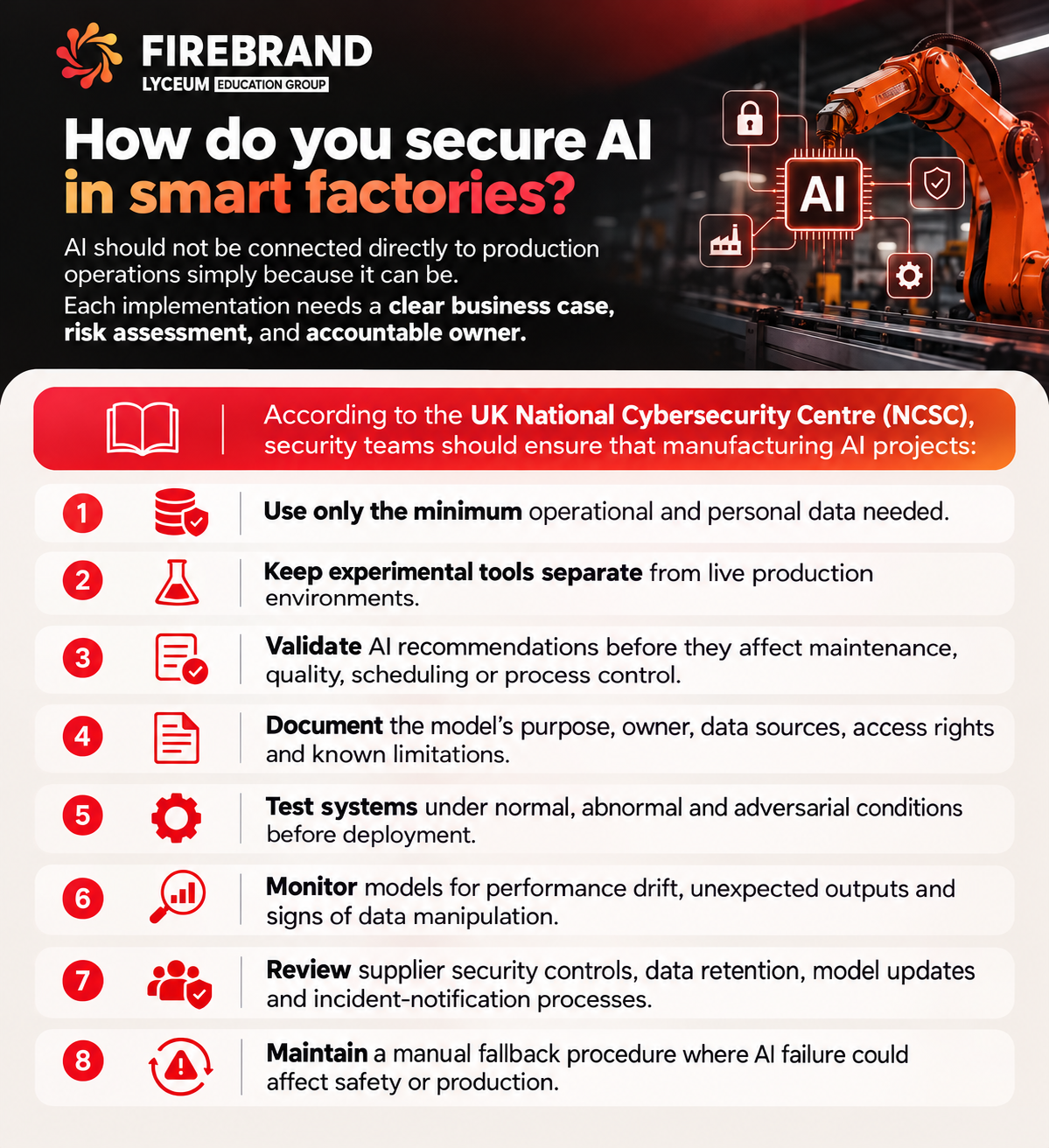
How do you secure AI in smart factories?
AI should not be connected directly to production operations simply because it can be.
Each implementation needs a clear business case, risk assessment, and accountable owner.
According to the UK National Cybersecurity Centre, security teams should ensure that manufacturing AI projects:
- Use only the minimum operational and personal data needed.
- Keep experimental tools separate from live production environments.
- Validate AI recommendations before they affect maintenance, quality, scheduling or process control.
- Document the model’s purpose, owner, data sources, access rights and known limitations.
- Test systems under normal, abnormal and adversarial conditions before deployment.
- Monitor models for performance drift, unexpected outputs and signs of data manipulation.
- Review supplier security controls, data retention, model updates and incident-notification processes.
- Maintain a manual fallback procedure where AI failure could affect safety or production.
What do you do after an AI attack hits a plant?
If an AI-enabled attack is suspected, act quickly. However, do not make unsafe changes to operational systems without involving plant and engineering leadership.
One of the first things you must do is to activate the cyber incident-response process and notify IT, OT, security and operational leaders.
Security teams must also assess whether affected systems could influence physical processes, equipment or people. Use established safety and shutdown procedures where required.
Of course, operational impact should also be assessed and all the communications must be done in secure and uncompromised channels.
How do you build cyber resilience for AI-enabled manufacturing?
AI-powered attacks are raising the stakes for manufacturing IT and security teams. Defending interconnected IT, OT, cloud, data and supplier environments requires more than basic awareness.
Firebrand can act as a training partner for manufacturers building that capability. It starts by identifying current and future skills gaps, then aligns learning to operational priorities, transformation programmes and role-specific requirements. Training can be delivered through residential, online or in-city options, helping teams gain relevant skills without unnecessary operational disruption.
Firebrand’s Lecture | Lab | Review method combines expert instruction, hands-on labs and structured review, helping learners translate knowledge into reliable performance in real-world roles. For manufacturing organisations, that means developing a workforce prepared to secure connected factory environments.
Firebrand also reports a 97% learner satisfaction rating, first-time pass rates above the industry average, and a Certification Guarantee that allows learners to retrain at no additional cost if they do not pass.
Build the skills your manufacturing operation needs before an AI-enabled incident tests them.
Enquire about the Firebrand Training Partner Programme